
By Brian Kopycinski
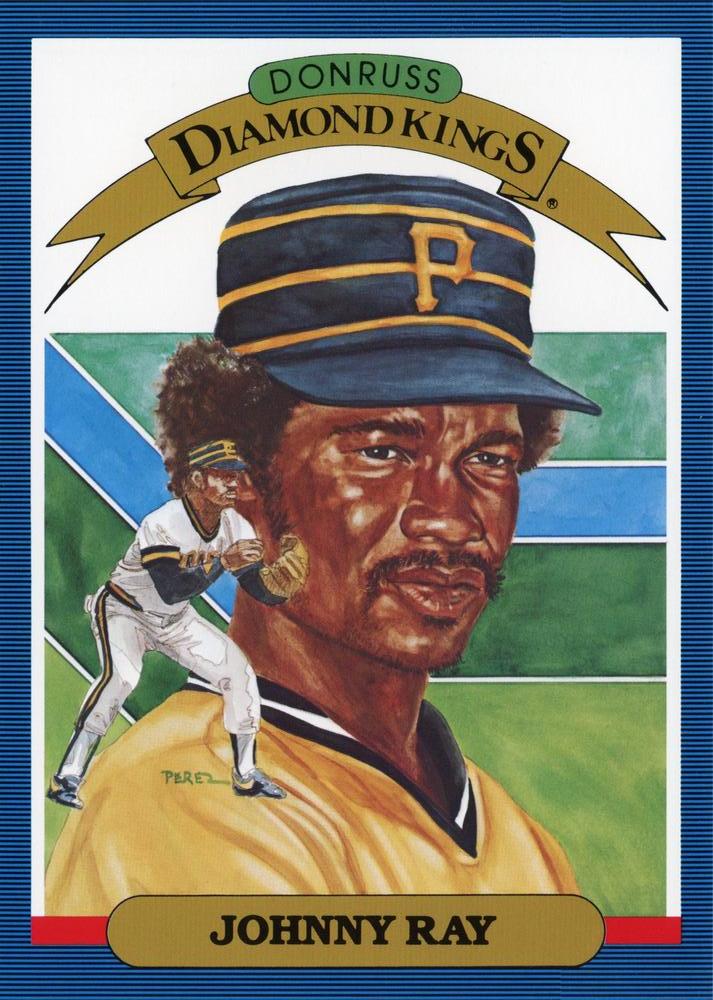
John Cornelius Ray, a native of Chouteau, Oklahoma, was a quiet star from a largely forgettable era of Pirates baseball. The switch-hitting second baseman, consistent and durable, was one of the few bright spots in the lineup on losing teams. Always a tough out, Ray was a line-drive hitter who drove the ball to the gaps, hit for a high average, and played solid defense. His Pirates tenure has been somewhat overlooked over the years. Outside of the late Bill Mazeroski, Ray stands as arguably the next greatest second baseman in Pirates history.
After graduating from Chouteau High School, Ray first attended Northeastern Oklahoma A&M College. In two seasons with the Golden Norsemen, he hit a whopping .439 and was named to the NCJAA All-Region team twice. Ray later transferred to the University of Arkansas. With the Razorbacks, he hit .319 in two seasons, leading the team with 47 RBIs in 1979. That year, Arkansas made it to the College World Series final, falling 2–1 to Cal State Fullerton in the championship game. Ray was a two-time All-Southwest Conference player. He was drafted by the Houston Astros in the 12th round of the 1979 MLB June Amateur Draft.
By 1981, Ray led the Pacific Coast League with 50 doubles for the Tucson Toros. On August 31, he was traded to the Pittsburgh Pirates with players to be named later, Randy Niemann and Kevin Houston, for “Scrap Iron” Phil Garner, a key member of the “We Are Family” Bucs. The following season, Ray became the Pirates’ everyday second baseman, starting in all 162 games. In his first month, he hit .342. After an impressive rookie campaign, Ray was named The Sporting News Rookie of the Year after slashing .281/.318/.382 with seven home runs and 63 RBIs, good for 3.8 bWAR. The BBWAA awarded its honor to Dodgers second baseman Steve Sax.
Over the next two seasons, Ray led the league in doubles with 38 each year. His best season with the Pirates came in ’83, when he won the Silver Slugger Award with a team-best 5.1 WAR. That year, Pittsburgh finished second in the NL East at 84–78. In ’84, Ray notched a career-best .312 average and 121 OPS+. By then, he was one of the hardest batters in the league to strike out, although he did not walk much. In 1985, Ray totaled 70 RBIs, striking out just 24 times in 594 at-bats. In Jim Leyland’s first year on the job, Ray was moved to third in the order. He had another outstanding season, was named the NL Player of the Month for April, and batted .301 with 78 RBIs in 155 games, though the Bucs stumbled to a last-place finish in the division.
Johnny Ray had established himself as one of the franchise’s best-hitting second basemen. Only George Grantham, a member of the 1925 World Series team, led Ray in batting average, though Grantham played more games at first than second with the Pirates. Pittsburgh was much improved in 1987, led by an exciting core of young talent. However, on August 29, Ray was traded to the California Angels for minor leaguer Bill Merrifield, father of Whit Merrifield, and a player to be named later, pitcher Miguel García. This opened a spot for José “Chico” Lind, who would man the keystone for the Bucs through the early ’90s.
Without Ray, the Pirates improved on their previous record in 1988, finishing second in the NL East behind the Mets at 85–75. Meanwhile, Ray himself had another career year, reaching personal bests in hits, doubles, and RBIs. He also learned a new position, playing 40 games in left field for the Halos in ’88. Ray was named an All-Star for the first time, finishing the campaign with a .306 average. In 1989, the Angels finished twenty games over .500 at 91–71, though they placed third in the AL West behind the Royals and eventual World Series champion Athletics. For Ray’s career with the Pirates and Angels, he never got to play for a true contender.
After the 1990 season with the Angels, Ray continued his professional career in Japan with the Yakult Swallows of the Central League. In his first season in NPB, he hit .299/.363/.480 with 11 home runs and 51 RBIs in 110 games. 1992 would be his last year in the game, as he hit just .190 in 49 games. Ray called it a career and returned home to Chouteau. That year, the Swallows won the Central League and played in the Japan Series, falling to the Seibu Lions in seven games. In ten Major League seasons, valued at 24.2 WAR by Baseball-Reference, Ray hit an exceptional .290. The only Pirates second basemen to collect more hits than him are Bill Mazeroski and Rennie Stennett.
Johnny Ray’s time in Pittsburgh was more than an afterthought. In the midst of controversy and scandal, the team struggled through the decade, yet Ray remained a silver lining. In franchise history, he ranks among the best at his position. Ray is a member of the Northeastern Oklahoma A&M Athletics Hall of Fame, the Southwest Conference Hall of Fame, and the University of Arkansas Sports Hall of Honor. While it is easier to remember the good times, let’s not forget players like Ray who still played meaningful baseball. They deserve more credit for their efforts—and then some.