-
Young Guns: Milan Kraft
By Brian Kopycinski
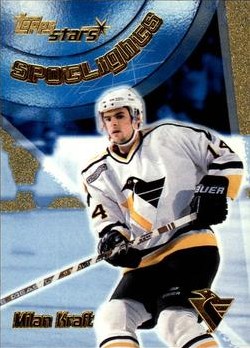
The Pittsburgh Penguins have had great success developing talent from the Czech Republic since the early 1990s, notably Jan Hrdina, Martin Straka, and, of course, Jaromír Jágr, following the end of communist rule in the country. From Dominik Hašek to David Pastrňák, Czechia has produced some of the best in the game. While the Penguins have certainly hit on some of these prospects, others haven’t exactly worked out. One such example is Milan Kraft, a big, strong forward and former first-round pick who showed promise but left the NHL for good after the 2004–05 lockout and returned home. His career, largely overlooked, was still noteworthy given all that he had accomplished at both the amateur and professional levels
Kraft was born and raised in Plzeň, the fourth largest city in the Czech Republic. He began his junior career with HC Plzeň, the same team his father, Milan, had played for in the 1970s and 1980s. In the younger Kraft’s debut season in 1995–96, he scored 54 goals and 41 assists in the CZE U18 league. Kraft later played in the Czech Extraliga before the Penguins drafted him in 1998. Following his selection, he moved to Canada and joined the Prince Albert Raiders of the WHL. Among the best Raiders alumni are Hockey Hall of Famer Mike Modano and Oilers star Leon Draisaitl.
With Prince Albert, Kraft scored 86 points and helped the team win the division title in 1998–99. He remained with the Raiders for 1999–00 and totaled 34 goals and 35 assists.
In what was perhaps the greatest moment of his career, Kraft and the Czech Republic defeated Russia in the 2000 World Junior Ice Hockey Championships. In the gold medal game, Kraft scored a goal in the 1–0 shootout victory to secure the country’s first title. He was named to the All-Star Team and awarded Best Forward of the tournament.
Kraft later joined the big club for the start of the 2000–01 season and scored his first NHL goal against the Rangers on October 14 at Mellon Arena. In his rookie year, he recorded seven goals and seven assists with the Penguins. He also played 40 games for Wilkes-Barre/Scranton in the AHL, totaling 44 points. He was named AHL Player of the Week in January 2001. The Penguins finished third in the Atlantic Division but made it all the way to the Conference Finals, losing to New Jersey in five games. Kraft appeared in eight playoff games but did not record a point.
After the season, the Penguins took a major blow by losing Jágr to the Capitals in free agency. Several other notable players also left via free agency or trade. Over the next few years, Pittsburgh would truly struggle for the first time since the mid-1980s, finishing at the bottom of the division. Much like the period before the arrival of Mario Lemieux, it wouldn’t be until Sidney Crosby became a Penguin that things started to turn around. Kraft split his time between Pittsburgh and Wilkes-Barre/Scranton during this stretch. His best season with the Penguins came in 2003–04, when he scored 19 goals and 21 assists. Still, the team finished in last place again. Mario Lemieux was no longer the player he once was, and a lockout was looming.
Kraft would go on to play for several Czech clubs over the next decade. He never returned to the NHL. While a new era of Penguins hockey was underway, Kraft went back to the Czech Extraliga. After a few seasons, he played one year for Avangard of the Russian Superleague, then returned to Czechia. Eventually, he signed with Chomutov of the Max liga, the second-tier league in the country.
Kraft later became the team’s captain and led the Pirates to two Czechia2 championships in 2009–10 and 2011–12. In the latter season, he totaled 22 goals and 33 assists. Chomutov was then promoted to the ELH. Kraft played one more year with the Pirates and retired after the 2012–13 season. Over his NHL career, he scored 41 goals and 41 assists. In the ELH, he notched 90 points. Since retiring, Kraft has been a youth hockey coach in the Plzeň area. His son, Daniel, most recently played for the HC Rokycany U17 team.
The Penguins, of course, won the Stanley Cup in 2008–09, ending a 17-year title drought. Not since the days of Lemieux and Jágr had the Pens been blessed with such talent. The core of Crosby, Fleury, Letang, and Malkin stuck together and won two more Cups in the next decade. While Milan Kraft was never a part of these teams, he still has much to be proud of. Had he returned to the NHL after the 2004–05 lockout, perhaps he could have been a productive bottom-six player in the years that followed. Kraft was a first-round pick, but it’s hard to call him a bust given his limited experience at the highest level. His career stands as one of the great “what ifs” in Penguins history.
-
Between the Pipes: Michel Dion
By Brian Kopycinski
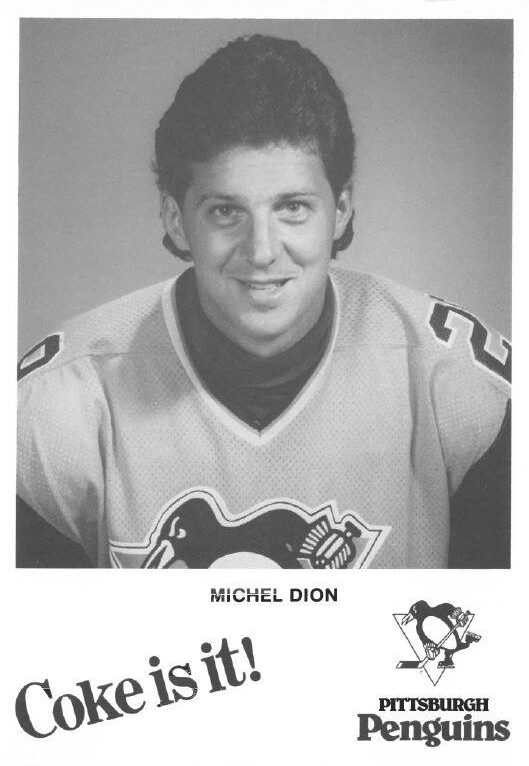
Born and raised in Montreal, former Pittsburgh Penguins goaltender Michel Dion began his professional career not in hockey, but with his hometown Montreal Expos. Following a notable junior hockey career, Dion went undrafted and later signed with the Expos, hoping to make it as a big-league catcher. His skills as a goalie translated well behind the plate, but it would not be long before he recommitted fully to hockey. Selected by the Indianapolis Racers of the rival WHA, Dion found immediate success at the professional level.
As the NHL and WHA eventually merged, Dion caught on with the Quebec Nordiques in his native province. After quitting on his team mid-game, he was soon traded to the Winnipeg Jets. Later becoming a free agent, Dion signed with Pittsburgh and enjoyed a career year, making the All-Star Game and finishing third in Vezina Trophy voting. That postseason, the Penguins nearly upset the reigning Stanley Cup champions, the New York Islanders, at the height of their dynasty. Through both triumph and turmoil, Dion’s strong faith sustained him.
Dion first found success in junior hockey before signing with the Expos. He excelled between the pipes for the Junior Canadiens of the OHA and the Red White and Blue of the QMJHL, both based in Montreal. After turning pro in baseball, Dion headed south. In 1972, he reached Class A with the West Palm Beach Expos of the Florida State League. Following a brief stint with the Cocoa Expos, he was promoted to West Palm Beach, where he backed up a future Hall of Famer, Gary Carter.
Dion showed promise at the plate, hitting .300 in ten at-bats. However, as a singles-hitting catcher lacking the power of Johnny Bench, he realized his future likely lay in hockey. Returning to the QMJHL with the Montreal Juniors, Dion was eventually drafted 121st overall by the Racers in the 1974 WHA Draft. He began his pro hockey career with the Mohawk Valley Comets before earning a call-up to Indianapolis.
The Racers’ inaugural season was 1974–75, and Dion appeared in just one game before opening the following year back in Mohawk Valley. His return to the WHA during the 1975–76 season proved spectacular. Dion posted a league-best 2.74 goals-against average and captured the Ben Hatskin Trophy as the WHA’s top goaltender. Indianapolis finished first in the East Division but fell in seven games to the New England Whalers in the quarterfinals.
Dion spent the entire 1976–77 season with Indianapolis as the team improved and returned to the playoffs, defeating the Cincinnati Stingers before losing to Quebec in the division finals. As a free agent, Dion signed with Cincinnati for 1977–78, winning 21 games and leading the league with four shutouts. After another season with the Stingers, he was selected by the Nordiques in the 1979 Dispersal Draft, returning home as the franchise entered the NHL.
Quebec faced its soon-to-be rival, the Montreal Canadiens, for the first time on October 13 at the Montreal Forum. Despite a 3–1 loss, Dion was named the game’s first star. Two weeks later, the Nordiques earned their first victory in the rivalry with a 5–4 win at the Quebec Coliseum. Still, Quebec struggled overall, finishing fifth in the Adams Division.
The following season brought excitement with the arrival of Peter Šťastný, but also one of the lowest moments of Dion’s career. In a home game against the Boston Bruins, Dion surrendered four goals before throwing his gear aside and leaving mid-game, driving straight to Montreal. He was eventually traded to Winnipeg in February.
After just 14 games with the Jets, Dion’s tenure ended. Pittsburgh took a chance on him in June 1981, desperate for stability in goal after Greg Millen struggled the previous season. With the opportunity to reclaim a starting role, Dion exceeded all expectations.
The 1981–82 season marked the pinnacle of Dion’s career. He won 25 games—his personal best—and was named the starting goaltender for the Wales Conference at the 34th NHL All-Star Game at the Capital Centre. The Wales Conference defeated the Campbell Conference 4–2, with Mike Bossy earning MVP honors. Dion finished third in Vezina voting, behind Islanders goaltender Billy Smith.
That postseason, Pittsburgh came within one game of eliminating the powerhouse Islanders in the division semifinals. New York jumped to a two-game lead before the Penguins rallied to force a decisive Game 5 at Nassau Coliseum. The Islanders prevailed 4–3 in overtime on a goal by John Tonelli.
Following the heartbreaking loss, both Dion and the Penguins declined. By 1984–85, Dion had been demoted to the Baltimore Skipjacks and appeared in just 10 NHL games. After that season, his professional career came to an end.
Dion retired following the 1984–85 season and later settled in Hilton Head, South Carolina, where he became a certified golf instructor. Drawing from his time in the Expos organization, Dion embraced life in the South and discovered a new passion in teaching.
His legacy in Pittsburgh also includes introducing the team chapel concept alongside teammate Paul Baxter. First exposed to the idea in Cincinnati, Dion later brought it to Quebec and continued the tradition with the Penguins—an enduring reflection of the faith that guided him throughout his career.
-
Greg Malone: Family Ties
By Brian Kopycinski
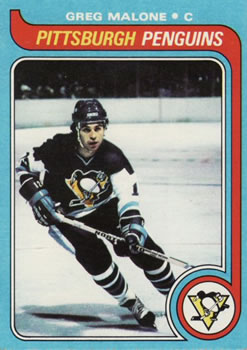
Before the arrival of Mario Lemieux, the upstart Pittsburgh Penguins had their fair share of talent, from Jean Pronovost to Rick Kehoe and Pierre Larouche. While these teams were often competitive, they ultimately fell short of their goal of hoisting Lord Stanley’s Cup. Early playoff exits became the norm through the early 1980s, before a steep drop-off forced the franchise into a necessary rebuilding period. One of the more underrated players from this era is Greg “Bugsy” Malone, who remains deeply tied to the city of Pittsburgh to this day. Although he last played for the Penguins more than forty years ago, Malone still ranks in the top 20 in franchise history in goals, assists, and points. His family’s enduring connection to the game further strengthens his lasting legacy.
Malone grew up in the Chatham neighborhood of Miramichi, New Brunswick, before his family later moved to Fredericton. There, he attended the local high school and played hockey. Malone helped lead the Fredericton Black Kats to a provincial championship in 1973, winning the scoring title with a remarkable 76 points (35 goals, 41 assists) in just 23 games. He went on to play junior hockey in the Ontario Hockey Association with the Oshawa Generals for three seasons, averaging 70 points per year. Malone was selected by the Penguins in the second round, 19th overall, of the 1976 NHL Amateur Draft. He made the immediate jump from junior to the NHL and suited up for Pittsburgh during the 1976–77 season.
Malone was a balanced forward, a dangerous goal-scorer and a reliable playmaker. As a rookie, he made an immediate impact, recording 18 goals and 19 assists on a Penguins team that returned to the playoffs. In a Preliminary Round rematch, the Penguins fell once again to the Toronto Maple Leafs, though Malone scored a goal in the Game 2 victory and added an assist in the deciding Game 3 loss. He followed up that strong debut with a 61-point campaign in 1977–78, despite Pittsburgh missing the postseason and finishing fourth in the Norris Division. Malone’s best season in a Penguins sweater came in 1978–79, when he posted a career-high 65 points (35 goals, 30 assists) while playing all 80 games. That year, the Penguins returned to the Stanley Cup playoffs and defeated the Buffalo Sabres 2–1 in the opening round, with Malone contributing an assist in the Game 2 loss at the Pittsburgh Civic Arena.
That momentum proved short-lived, as the Penguins were swept by the Boston Bruins in the Quarter-Finals. Malone was held scoreless in the series, and Pittsburgh once more fell short of a deeper playoff run. In the seasons that followed, Malone remained a reliable presence, recording back-to-back 50-point campaigns. The team’s struggles persisted, with early playoff exits against the Bruins in 1980 and the St. Louis Blues in 1981. Malone maintained this production despite playing only 51 and 62 games in those respective seasons. A down year followed in 1981–82, as the Penguins were eliminated in the Preliminary Round by the Islanders. Malone rebounded in 1982–83 with another 60-point season, highlighted by a career-best 44 assists. The team, however, was in clear decline, finishing 18–53–9 for just 45 points. With a full rebuild underway, Malone was traded to the Hartford Whalers in September 1983 for a fifth-round draft pick.
Regardless of where he played, Malone continued to produce offensively. On struggling Whalers teams, he posted 54- and 61-point seasons, even as Hartford remained near the bottom of the Adams Division. He was traded midway through the 1985–86 season to the Quebec Nordiques in exchange for former Penguin Wayne Babych. By this stage of his career, Malone was no longer the impact player he once was, recording just 21 points between the two teams that season. After appearing in only six games for the Nordiques the following year, his playing career came to an end. Over 11 NHL seasons, Malone totaled 191 goals and 310 assists for 501 points. It did not take long for him to return to the game in a different capacity.
Hired by the legendary Tony Esposito, who served as the Penguins’ general manager, Malone became a scout for his former club. He eventually rose to the role of chief scout and earned two Stanley Cup rings for his work in the front office. Malone held that position in Pittsburgh until 2006 before later joining the Phoenix Coyotes organization. He ultimately settled in the Steel City, where he raised his two sons, Ryan and Mark.
Ryan Malone was selected by the Penguins in the fourth round of the 1999 NHL Draft and spent four seasons with the team before later playing for the Tampa Bay Lightning and New York Rangers. Greg and Ryan achieved a rare distinction, becoming one of only two father-son duos in NHL history to each record a hat trick, the others being Ken Hodge Sr. and Ken Hodge Jr. Mark Malone played collegiate hockey at Nichols College before embarking on a professional career in the ECHL with the Wheeling Nailers and Bakersfield Condors. Greg’s brother, Jim Malone, was a first-round pick of the New York Rangers in 1980 and enjoyed a lengthy professional career of his own. Jim’s son and Greg’s nephew, Brad Malone, went on to play parts of nine NHL seasons.
Greg Malone was inducted into the New Brunswick Sports Hall of Fame in 2000 and later founded the Malone Family Foundation, which helps provide access to hockey through equipment and facilities for local families in need. Through his playing career, front-office contributions, and continued commitment to the sport, Malone has left a lasting impression on the city of Pittsburgh. He remains an overlooked star from the franchise’s early years and one of the Penguins’ most important players of the pre-Lemieux era.
-
Phil Bourque: The Ol’ Two-Niner
By Brian Kopycinski
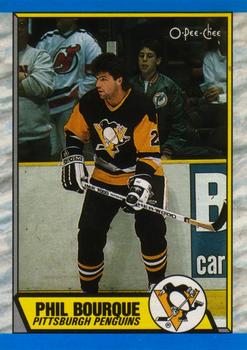
Phil Bourque grew up outside of Boston in Chelmsford, Massachusetts, but considers Pittsburgh to be his home. A fan favorite for his work on and off the ice, the Steel City has embraced the two-time Stanley Cup champion as one of their own. Bourque’s story is one of resilience, from his early years through his playing days. For all that he’s done in his career and life, Phil Bourque is simply legendary.
Boston has always been a hockey town, as home of one of the original six teams. When Bourque was a kid, the Bruins were winning Stanley Cups with stars like Bobby Orr and Phil Esposito. From a very young age, Bourque was a natural skater. He grew up playing in the backyard with his two brothers, on an outdoor rink their father had built. Bourque showed his versatility early on in youth hockey, playing both ways. Unfortunately, he was a victim of verbal and physical abuse from his father on a regular basis. The two had a complicated relationship and eventually reconciled years later.
Bourque played two seasons for the Kingston Canadians in the OHL. He went undrafted in the ‘82 cycle but received offers from his hometown Bruins and the Pittsburgh Penguins. Bourque chose Pittsburgh in part to get away from his father. The Penguins had also made him a better offer. Soon after, he joined the Baltimore Skipjacks of the AHL. Bourque began his career as an offensive-minded blue liner. He made his debut with the Penguins in 1983-84. Bourque then spent the next several seasons up and down between the AHL and NHL before finally becoming a Penguins regular in 1988-89. He made the difficult transition from defenseman to left wing, scoring 43 points in his first full year.
That season, Pittsburgh finished second in the Patrick Division with 87 points and made the playoffs. Bourque scored three goals in the Pens’ sweep of the Rangers in the opening Semi-Finals. He also scored the winning goal in overtime in Game 3 of the Division Finals at Philadelphia, a series Pittsburgh would go on to lose in seven games. After an impressive showing, Bourque followed this with a career high 22 goals in 1989-90. While the Penguins missed the playoffs that season, they later drafted Jaromír Jágr that summer. Things were looking up in Pittsburgh in the new decade.
The early ‘90s were a special time for Pittsburgh hockey. The team was stacked with talent, with several Hall of Famers filling the lineup. Mario Lemieux was the best player in the game. Phil Bourque was a valuable contributor to these back-to-back Stanley Cup champions. For 1990-91, he netted 34 points in the regular season, and added 13 points in the playoffs, notably scoring two goals in the Finals against Minnesota. Next year, the Pens finished third in the Patrick Division but ran the table again to play for the Stanley Cup. In Game 1 of the Finals, Bourque scored a goal in the first period that helped kickstart the Pens’ comeback victory. Pittsburgh ended up sweeping Chicago to claim the franchise’s second title.
For the 1992-93 season, Bourque signed with the New York Rangers, where his production gradually declined. He was traded to the Ottawa Senators in March 1994, where he received limited playing time. Bourque nearly died in a rock-climbing accident at Lake Powell in the offseason, falling from about 40-feet, face first. He broke his neck in three places, fractured his skull, his nose; it was a minor miracle that he lived. His friends acted quickly and found park rangers to assist him, sending a helicopter that life-flighted him out to a hospital in Flagstaff. Had he not been in the best shape of his life, the fall likely would have killed him, doctors later said. The NHL lockout delayed the start of the upcoming season until January, and Bourque was able to make a recovery in time to play.
Those early Senators teams were hard to watch, always one of the worst teams in the league. Bourque played sparingly in Ottawa, and left the NHL after the 1995-96 season, joining the IHL. He spent time with the Detroit Vipers and Chicago Wolves before deciding to play overseas in Germany. Bourque called it a career after the 1999-00 season spent with the Hamburg Crocodiles of the 2nd Bundesliga. For his 12-year NHL career, he totaled 199 points, won two Stanley Cups, and endeared himself to fans with his physical, gritty style of play. A few years later, Bourque joined Mike Lange in the broadcast booth as a color commentator. He has remained with the Penguins organization ever since.
-
Young Guns: “Lucky” Pierre Larouche
By Brian Kopycinski
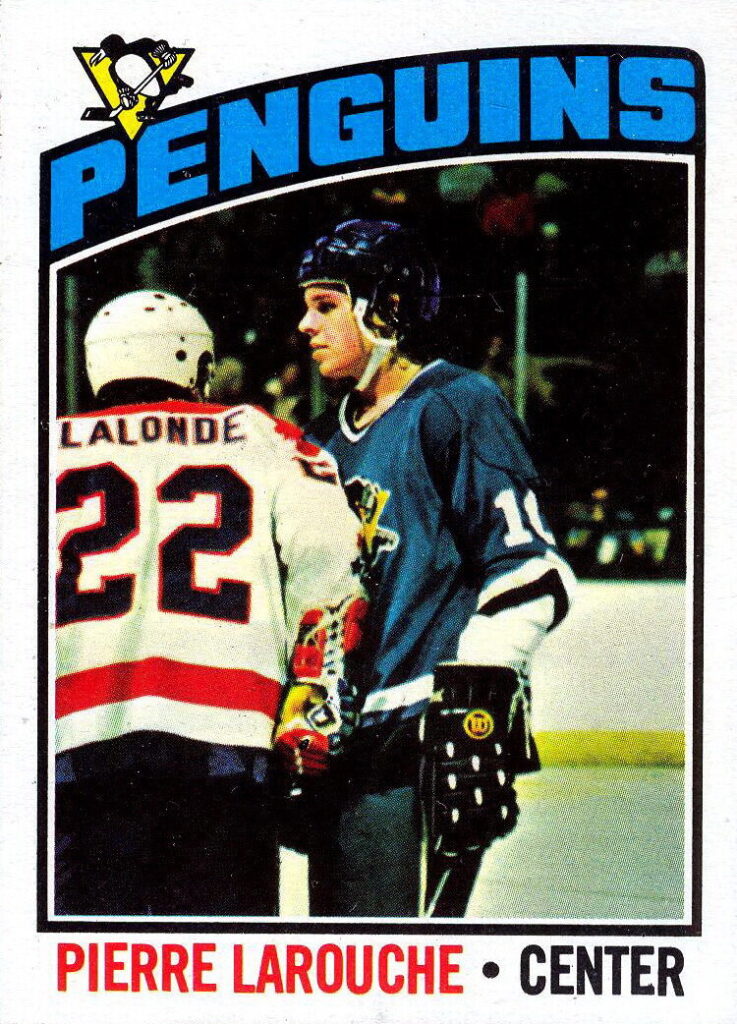
In the early years of the franchise, the expansion Pittsburgh Penguins faced stiff competition in the league’s West Division, most notably from the Chicago Blackhawks and the Philadelphia Flyers. While the Pens did eventually make the playoffs, this success was short-lived, as the team fell early in the postseason in both 1970 and 1972. Back then, center Jean Pronovost was their best player and leader on the ice. To truly compete with the Boston Bruins, Montreal Canadiens, and Flyers for a Stanley Cup, the Penguins needed greater firepower in their lineup. In 1974, with the 8th overall pick, Pittsburgh selected Pierre Larouche, “Lucky” Pierre.
The Amos, Quebec pond skater grew up playing backyard hockey about 350 miles north of Montreal. Early into his hockey career, Larouche showed signs of greatness. With the Sorel Éperviers of the QMJHL, he recorded a whopping 251 points for the 1973-74 season. As the league’s top scorer with 94 goals and 157 assists, he was awarded the Jean Béliveau Trophy. This impressive record stood until Le Magnifique himself, Mario Lemieux, broke it playing for the Laval Voisins with 282 points in 1983-84. Larouche was also drafted by the Houston Aeros of the WHA in 1974 but opted for the direct transition to the National Hockey League with the Penguins.
Larouche, a finesse goal-scoring forward, joined an up-and-coming Penguins team that now featured winger Rick Kehoe, acquired in a trade from the Toronto Maple Leafs. Pittsburgh had moved to the Norris Division of the Prince of Wales Conference, the same season the expansion Washington Capitals and Kansas City Scouts joined the league. Larouche’s rookie year was simply phenomenal. At just 19, he scored 31 goals and added 37 assists for 68 total points. Larouche finished second in the Calder Memorial Trophy voting to the Atlanta Flames’ Eric Vail, though it’s up for debate who really deserved the honor.
That year, the Pens returned to the postseason, sweeping the St. Louis Blues in the Preliminary Round 2-0, with Larouche scoring the game-winning goal in Game 1. Pittsburgh lost in the next round to the New York Islanders in seven games. Next season, head coach Marc Boileau was fired after the Penguins got off to a poor start. The team played much better under Ken Schinkel, who had recently retired as a player after six seasons with Pittsburgh. While the Pens lost in the Preliminary Round to the Maple Leafs, the 1975-76 season was still one to remember. Larouche had the finest year of his career, breaking the 100-point threshold, scoring 53 goals with 58 assists. He became the youngest Penguin to score 50 goals, and youngest to hit 100 points with 50 goals, a record that stood until “The Great One” Wayne Gretzky came around.
Larouche and Pronovost were among the best players in the game. The duo was named to the NHL All Star game, ranking 3rd and 4th in league goal scoring, respectively. By now, Larouche had become known for his brash and outspoken personality. He had another good season with the Pens in 1976-77, as Pittsburgh fell again in the opening round to Toronto. To some, Larouche had outworn his welcome. An infamous quote has been attributed to him, saying to teammates, “…if they want me to play defense, they can pay me another $150,000.” Frustration had grown on both sides, and Larouche was traded during the 1977-78 season to his hometown Canadiens. Idolizing Guy Lafleur, he changed his jersey number from 10 to 28 out of respect for “The Flower”.
This change of scenery quickly paid dividends. The Habs were in the midst of their dynasty, with Larouche eventually playing on the same line as his hero Lafleur. For the 1979-80 season, Larouche once again hit the 50-goal mark, also notching 41 assists. Still, despite helping the Canadiens win two Cups, Larouche had been criticized for his personality and unbalanced play. Deemed expendable, he was dealt to the hapless Hartford Whalers partway through the 1981-82 season. The Whalers back then were just awful, and while Larouche had a few good years in Hartford, it was hardly enough to turn the depleted franchise’s hopes around.
Larouche had one more stop in his NHL career, the New York Rangers, where he returned to form. For 1983-84, he was an All-Star for the second and final time, scoring 48 goals in the regular season. Larouche enjoyed a nice stretch with the Rangers on competitive teams. New York reached the Conference Finals in 1986 but lost to the Canadiens. Larouche’s career ended in 1987 just after the start of the season, suffering a serious back injury in the first month of play. To that point, he had 12 points in 10 games, clearly still a threat on the ice. By then, the game had become more physical. Larouche has said that he always related more to the goal scorers like Gretzky and Mike Bossy.
Had Larouche remained in Pittsburgh for his career, the Pens still likely wouldn’t have won a Cup. While they certainly could have made deeper playoff runs, defeating the Canadiens or the Islanders at the height of their dominance would have been near impossible. You could argue that Larouche’s 1975-76 season was the best from a Penguins player before the emergence of Lemieux. For his career, Larouche scored 395 goals with 427 assists, for 822 points. “Lucky” Pierre Larouche remains one of the greatest Pens of his era. His remarkable presence, both on and off the ice, won’t be forgotten any time soon.
-
Jordan Staal’s Exceptional Rookie Year
By Brian Kopycinski
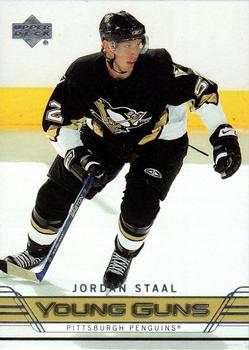
The Pittsburgh Penguins of the 2000s were a team in transition, from Mario Lemieux to Sidney Crosby. After a few poor seasons, not to mention a league-wide lockout, things were looking up after the selections of Crosby, Marc-André Fleury and Evgeni Malkin. The turnaround was quick. The team went from a record of 22-46-14 to 47-24-11, from 2005-06 to 2006-07.
Following Crosby’s historic rookie year, Malkin, the Soviet born second-overall pick of the ‘04 draft, looked to keep this momentum going as a potential Calder Memorial Trophy winner, after Sid lost out to Alexander Ovechkin. While the name Jordan Staal hasn’t necessarily been forgotten by Pens fans, what Staal did his first year in the league, making the direct jump from junior hockey to the NHL, simply doesn’t get talked about enough.
Jordan, the third of four boys, all to play in the NHL, grew up in Thunder Bay, Ontario, located on Lake Superior. He played two seasons in the OHL for the Peterborough Petes, about two hours northeast of Toronto. Considered one of the top prospects in the 2006 cycle, the Penguins drafted Staal second-overall, behind American defenseman Erik Johnson.
For his rookie season, Staal played in 81 out of a possible 82 games and set several records that still stand to this day. As an 18-year-old, he scored goals and played great defense. The most notable of his achievements include becoming the youngest player to score a hat trick and setting the record for the most shorthanded goals by a rookie in a season with 7.
Staal was third on the team in goals with 29, behind Crosby and Malkin, and led the Pens with a +16 +/- line. For his efforts, he was named to the NHL All-Rookie Team, alongside his teammate Geno, and finished third in the Calder Trophy voting, the honor awarded to Malkin. In the years since, Staal remained a valuable member of the Conference Finals and Stanley Cup teams.
His play made him a fan favorite in Pittsburgh. Sadly, Staal wouldn’t spend the majority of his career in the black and gold. On Draft Day in 2012, hosted at Consol Energy Center, he was traded to the Carolina Hurricanes for Brandon Sutter, Brian Dumoulin, and the eighth-overall pick. The Penguins used this selection on defenseman Derrick Pouliot.
Staal joined his older brother Eric in Carolina, where he has enjoyed his best years. In 2019, he succeeded Justin Williams to become the Hurricanes’ captain, the same honor his brother wore proudly on his sweater for many years. Carolina easily won this trade. Pouliot was a bust. Sutter had a few good years. Dumoulin was the best of the return. While Staal wasn’t a part of the back-to-back Penguins Stanley Cup run, he’s been great for the Canes, and helped lead them to consecutive Division championships in recent years.
At the age of 37, Staal has shown no major signs of slowing down, having only missed significant time due to injury twice in his Hurricanes career. While Ron Francis holds the record for most games in franchise history (with the Hartford Whalers), Staal leads all Canes players with 937 and counting. Staal is a natural leader, one you can’t win without.
Whether this happens in Carolina or elsewhere, he’s a proven winner already with what he’s accomplished in a Penguins uniform. Looking back, Staal went from being fresh out of school to one of the top rookies in the NHL. His accomplishments on the ice have added to a lasting legacy that extends beyond himself to his brothers and all they’ve done, as one of the greatest hockey families of all-time.
-
Ryan Malone: Pittsburgh, Penguin
By Brian Kopycinski
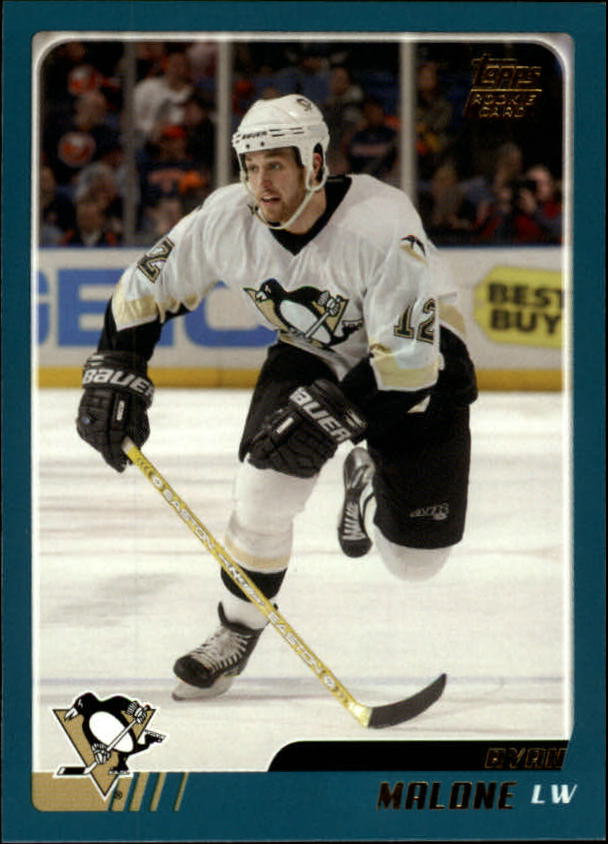
Pro hockey has been a part of Pittsburgh’s sports legacy since the 1920s. For nearly forty years, the Pittsburgh Penguins, founded in 1967, skated in black and gold (and once, powder blue) without ever dressing a player born in the city. That all changed at the start of the 2003-04 season as Ryan Malone, a 23-year-old forward from the South Hills, made his NHL debut against the Los Angeles Kings at Mellon Arena. At long last, the Penguins had a hometown kid in the lineup.
While the Pens lost their season opener, it was just the beginning of a promising career for the young left winger Malone. The son of a Penguin, Ryan was born in 1979, during a rough stretch in franchise history before Mario Lemieux came into the picture. His father, Greg, a gritty center from New Brunswick, Canada, spent seven seasons in Pittsburgh, scoring a career high 35 goals in ‘78-’79, and later went on to become a respected scout. Ryan grew up in the shadow of Civic Arena, watching his dad on the ice, and dreamed of doing the same.
His path to the league wasn’t a straight one. After two years at Upper St. Clair, Malone transferred to Shattuck-St. Mary’s in Minnesota for his junior year, the same prep powerhouse that Sidney Crosby would later star for. Malone finished high school in Omaha while tearing up the USHL with the Lancers, a junior hockey team that would soon produce future Penguins defenseman Alex Goligoski. Pittsburgh liked what they saw in Malone took a chance on the hometown kid, drafting him in the 4th round of the 1999 NHL Draft. Four solid years at St. Cloud State followed, then a brief stint with the Wilkes-Barre/Scranton Penguins.
When Malone finally cracked the big club in ‘03-’04, he wasted no time. 22 goals, the most on the team. 43 points, good for third. An All-Rookie Team nod, and votes for the Calder Memorial Trophy. For a season in which Mario Lemieux managed only ten games, the kid from Pittsburgh helped carry the offense, alongside other notable rookies Marc-André Fleury and Brooks Orpik. The lockout wiped out 2004-05, but when play resumed, Malone continued to produce and eventually found himself on Sidney Crosby’s wing with veteran Marc Recchi. The chemistry was there. On December 15, 2006, at the Igloo, he recorded his first career hat trick against the New York Islanders, joining an exclusive club of father-son duos to accomplish the feat that includes the legendary pair of Bobby and Brett Hull.
2007-08 was arguably Malone’s finest year on the ice, with 27 goals and 51 points in the regular season, and a standout performance in the playoffs, 6 goals and 16 points in twenty games. That year, the Pens went on a run that ended in the Stanley Cup Finals, falling to the Detroit Red Wings in six games. Pittsburgh would have to wait a bit longer to hoist Lord Stanley’s cup once again. Unfortunately for Malone, this would come without him. He would be traded to the Tampa Bay Lightning not long after the Penguins lost to the Red Wings, on June 28, in a package with Gary Roberts in exchange for a 3rd round pick in the 2009 draft. Ben Hanowski, who the Penguins would later select with this pick, never played a game for Pittsburgh. He himself was a part of another big trade that saw the Pens acquire Jarome Iginla in 2013.
Malone would sign a seven year, $31.5 million deal with Tampa Bay, leaving home after four memorable seasons. This move didn’t slow him down, not in the slightest. Malone posted back-to-back 20 goal seasons, helping lead the Lightning to the Eastern Conference finals in 2011. The Boston Bruins won the series in seven games, and later the Stanley Cup in the same fashion over the Vancouver Canucks. Malone also earned a silver medal with Team USA in the 2010 Winter Olympics held in Vancouver that year, watching his old lineman Crosby score the winning goal in overtime to claim gold for Canada.
The later years were quieter. A 2014 arrest for a DUI and cocaine possession led to his release by Tampa in August. Malone then signed with the New York Rangers in September, appearing in just six games for them that season. After a year off from hockey came a failed comeback attempt with the Minnesota Wild, and a final twelve game cameo in the AHL with the Iowa Wild, before Malone hung up his skates for good.
Ryan “Bugsy” Malone never lifted a cup in Pittsburgh, yet no one can take away what he gave the team and the city in those early Crosby years. His career stands as proof that you don’t have to come from a hotbed of talent to make it in the game. Malone served as a bridge between the Lemieux and Crosby eras as the local heartbeat on rosters filled with imports.
More than twenty years after his debut, the city of Pittsburgh has produced plenty of NHL talent, such as J.T. Miller and Brandon Saad, but Ryan Malone will always be the first to wear the Penguins black and gold. He is the first “Pittsburgh” Penguin.

Pittsburgh Sports History