
By Brian Kopycinski
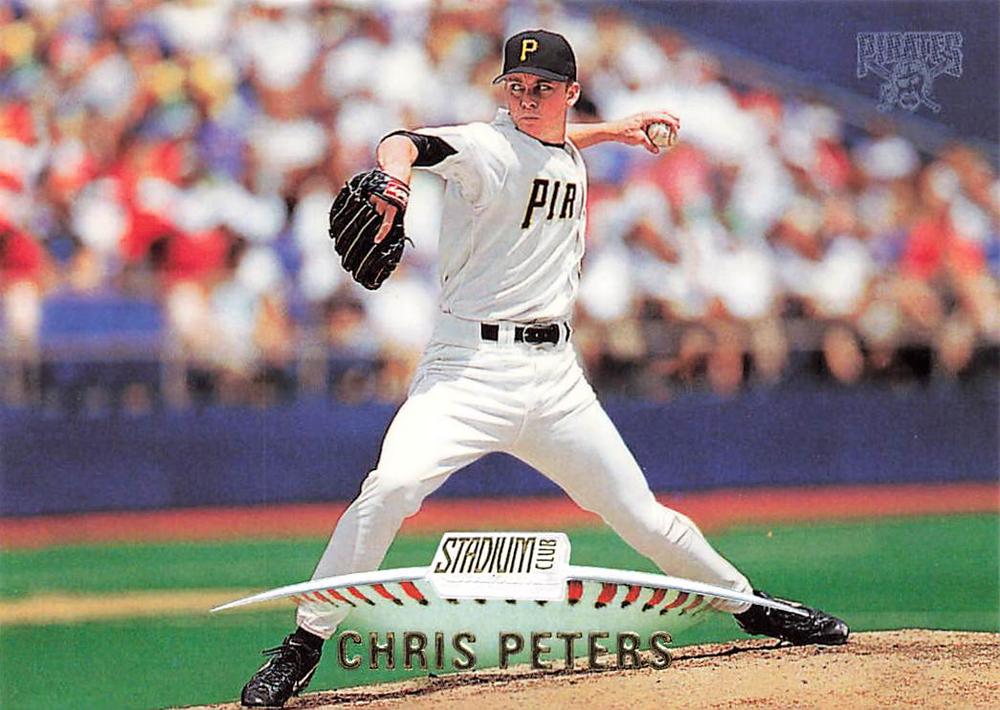
A quick glance at Chris Peters’ Baseball-Reference page suggests very little: just six seasons in the majors, a losing record, and a career 4.81 ERA. When you look beyond the surface, however, there’s much more to his story than the numbers indicate. The same can be said for countless big leaguers who make it but fail to leave a lasting mark on the game. While fans tend to focus on the extraordinary, it’s sometimes the opposite that makes for the most compelling narratives.
The journey is often more important than the destination. For someone like Chris Peters, a hometown kid, his path to the show followed a traditional course. He spent time with the Pirates during a memorable stretch and, for a brief window, performed exceptionally at the highest level. Peters last pitched for Pittsburgh in 2000 and retired from professional baseball after the 2003 season. More than a decade later, he surprisingly returned to the Pirates organization in a fitting role. After so many years of losing, Peters was finally part of a winning team in Pittsburgh, just not in the way many might expect.
Peters was born in Fort Thomas, Kentucky, in the greater Cincinnati area. His family later moved to Peters Township in Washington County when he was a child. At Peters Township High School, Chris captained the baseball team during his senior year. He went 18-4 as a pitcher in high school and also lettered in basketball. Peters was left-handed and had a great arm, but he was undersized, listed at 6-foot-1 and 162 pounds on Baseball-Reference. He later attended Indiana University Bloomington. In three years with the Hoosiers, Peters won 19 games and struck out 224 batters while making 49 career starts. He was then selected by the Pirates in the 37th round of the 1993 draft and debuted that year for the Welland Pirates of the New York-Penn League.
It would be a strongly discouraging season for the big club following three straight NL East titles. “The Slide” truly began after the 1992 NLCS, marking the start of twenty consecutive losing seasons. Peters, to his credit, quickly worked his way through the Pirates system as a pitcher drafted out of college. At Advanced-A Lynchburg in 1995, he dominated with an 11-5 record, a 2.43 ERA, and 132 strikeouts in 24 starts. Peters made his major league debut the following season in relief against the Cincinnati Reds at Three Rivers Stadium on July 19. As a rookie, he made 10 starts in 16 total appearances, going 2-4 with a 5.63 ERA in 64 innings pitched. For the second straight year, the Bucs finished fifth in the division.
1997 was a memorable year in Pirates history, as “The Freak Show,” a ragtag group of rookies and veterans under new manager Gene Lamont, greatly exceeded expectations and pushed for the division title deep into September. Instead of losing 100 games, as many predicted, the Pirates stayed in contention with the Houston Astros for the NL Central crown before ultimately finishing five games back. Peters served primarily as a reliever on this team, though he also spent part of the season in Triple-A Calgary. He made 31 appearances out of the bullpen and posted a 4.58 ERA in 37.1 innings pitched. His best season in the majors came the following year. In 1998, Peters started a career-high 21 games and went 8-10 with a much improved 3.47 ERA across 148 innings, striking out 103 batters.
His finest start came on July 29, when he threw a complete game against the Colorado Rockies at Coors Field. Peters yielded just five hits while striking out seven and walking two in the Bucs’ 12-1 victory. Baseball-Reference values Peters’ 1998 season at 3.2 WAR. The Pirates rotation that year was young and unproven, consisting of Peters, Jason Schmidt, Francisco Córdova, Jon Lieber, José Silva, and Esteban Loaiza. While Córdova had the best season of the group, and there were bright spots in the lineup such as Jason Kendall and Kevin Young, the Pirates still finished dead last in the Central after seriously competing just one year earlier.
Brian Giles arrived from the Cleveland Indians that offseason in a one-for-one trade that sent Ricardo Rincón the other way. Giles enjoyed a career year, and the Pirates improved by nine wins en route to a third-place finish in the division. Peters, meanwhile, battled injuries and struggled in 1999. He later underwent surgery, and his arm was never quite the same. That season, he made just 11 starts, going 5-4 with a 6.59 ERA. Peters rehabbed and eventually returned to the Bucs in 2000, the final season played at Three Rivers Stadium. Used exclusively as a reliever, he delivered promising results, posting a 2.86 ERA in 28.1 innings over 18 appearances.
Peters was granted free agency and later signed with the Montreal Expos for the 2001 season. There, he split time between starting and relieving but struggled with his new club. Peters was released in May and later caught on with the Reds and then the Yankees, remaining in Triple-A for the remainder of the year. That proved to be his last taste of big-league action, as he spent the rest of his professional career bouncing between the minors and independent baseball. Peters spent time in the Blue Jays, Tigers, and Devil Rays organizations, along with a stint for the Newark Bears of the Atlantic League under manager Bill Madlock.
Adjusting to life after baseball, Peters sold cars at a South Hills dealership for a time before managing several parking lots in Downtown Pittsburgh and Oakland. He has also served as a pitching instructor and coach for local youth teams. Recently, his South Hills team reached the Pony League World Series in 2025. Peters was once the pitching coach at Point Park University as well. Though his playing days were over, he still found ways to stay involved in the game and make a difference. For years, Pirates manager Clint Hurdle wanted Peters on his staff. In 2015, that opportunity finally came, as Peters was hired as a left-handed batting practice pitcher. That Pirates team won 98 games, the franchise’s best record of the 21st century so far. While the Bucs ultimately lost to the Cubs in the Wild Card Game, those teams remain special to Pittsburghers of a certain generation. It took time, but Chris Peters finally became part of a winner with his hometown club.
Peters has remained active in the Pirates’ alumni network through charity work and youth camps. In 2022, he was inducted into the Pennsylvania Sports Hall of Fame as a member of the Washington/Greene County Chapter.