
By Brian Kopycinski
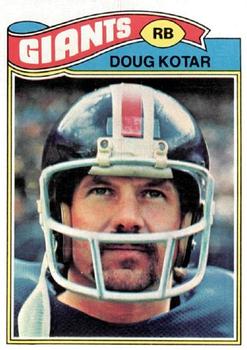
The region of Western Pennsylvania has produced some of the greatest talents in NFL history. It is known to some as the “Cradle of Quarterbacks”, as the home of Dan Marino, Joe Montana, Joe Namath, and Johnny Unitas. On the defensive side, Aaron Donald and Darrelle Revis shined bright; both are widely regarded as among the best ever at their respective positions. Pittsburgh is a gritty, blue-collar town. Its native sons reflect this identity on and off the field. This incredible legacy is undeniable. Over the years, many of its stars built their legends on the biggest stage, while others equally deserving have been largely overlooked in the game’s broader history. Through my writing, I aim to highlight those who’ve been denied the recognition they deserve. The first who came to mind? Doug Kotar, a running back who embodied that tough, ironclad spirit for the New York Giants.
Kotar hailed from Muse, a small town just outside of Canonsburg, in Washington County. At Canon-McMillan High School, he excelled not only in football but also in baseball and track and field, competing in the javelin and shot put. A natural athlete, he was drafted by the Cincinnati Reds as an outfielder in the 16th round of the 1970 MLB Draft. From his earliest years on the gridiron, he was an impact player. An Observer-Reporter column from a few years back chronicled his rise from high school to the pros, featuring a defining performance from his senior season against Chambersburg.
On the first play from scrimmage, Kotar scored on a 70-yard option run after a pitch from quarterback Mike Smutney. Later, in the fourth quarter, he broke free on a 92-yard kickoff return to seal the win for the Big Macs. Kotar became the first Canon-McMillan graduate to reach the NFL, a distinction that stood alone for more than four decades. The next came in 2015, when Penn State linebacker Mike Hull signed with the Dolphins. From Kotar’s era, right-hander Tom Dettore appeared in parts of four big-league seasons with the Pirates (1973) and Cubs (1974-1976). One can only wonder whether Kotar might have reached the majors had he pursued baseball, though breaking into the Big Red Machine’s outfield behind George Foster, César Gerónimo, and Ken Griffey Sr. would have been a tall order.
After high school, Kotar headed to the University of Kentucky. The Wildcats never won more than five games during his time there, facing stiff competition in the SEC. Over three seasons, Kotar piled up 1,167 rushing yards while sharing the backfield with Sonny Collins, a future second-round pick of the Falcons in 1976. Another standout teammate was linebacker Joe Federspiel, a ten-year NFL veteran and member of the New Orleans Saints Hall of Fame. On September 11, 1971, in his first varsity game against Clemson at Memorial Stadium, Kotar, then a sophomore, took the opening kickoff 98 yards to the house, helping Kentucky to a 13-10 win over the Tigers.
Listed at just 5’10 ½” and 205 pounds, Kotar was an undersized, hard-nosed runner. His college numbers were solid but unspectacular. The odds were stacked against him. Undrafted in 1974, he signed as a free agent with his hometown Steelers, only to be traded to the Giants soon after. In exchange, Pittsburgh received quarterback Leo Gasienica, a Rutgers product who later played for the Birmingham Vulcans of the World Football League. The Giants opened the season “at home” against the Redskins, not in New York, but at the Yale Bowl in New Haven, Connecticut, a temporary venue while Yankee Stadium was being renovated. The following year, they played at Shea Stadium before settling into their permanent home, Giants Stadium, in East Rutherford, New Jersey.
Kotar made an immediate impression in his NFL debut, scoring a touchdown and leading the Giants with 43 rushing yards in a close 13-10 loss. He wore #44, the same number worn today by another bruising back, Cam Skattebo. A few weeks later against the Falcons, he posted a career-high 119 yards and another score, his third touchdown in four games. The Giants still fell 14-7, starting the year 1-3. The team was mired in a postseason drought dating back to 1963. Over his first two seasons, Kotar racked up 755 kick-return yards, proving his value and versatility. His finest all-around year came in 1976, when he eclipsed 1,000 all-purpose yards (731 rushing, 319 receiving) and led the Giants in rushing, edging future Hall of Famer Larry Csonka’s 569. He again led the team in 1978, with 625 yards on the ground.
A number of notable personalities made up these Giants teams. Marty Schottenheimer, the linebackers coach and later defensive coordinator, was born in Canonsburg and played his college ball at Pitt. A former defensive back, Schottenheimer won an AFL Championship with the Buffalo Bills as a rookie. Bill Belichick and Romeo Crennel also spent the early parts of their coaching careers with the Giants in various roles. During Kotar’s tenure, he played under three head coaches: Bill Arnsparger, John McVay, and Ray Perkins.
When Kotar was a rookie, his quarterback was Craig Morton, who had previously won a championship with the Cowboys and later faced them as a member of the Broncos in Super Bowl XII. By 1979, Phil Simms, a first-round draft pick, had become the franchise’s future. Billy Taylor led the team that season with exactly 700 rushing yards, while Kotar was close behind with 616. Both contributed over 200 yards receiving. Unfortunately, Kotar’s fortunes turned the following year. He missed the entire 1980 campaign after tearing ligaments in his left knee. Without him, the Giants faltered, finishing fifth in the NFC East at 4-12.
The 1981 season, however, would be different. Led by rookie phenom and future Hall of Famer Lawrence Taylor, who earned Defensive Player of the Year honors, the Giants finished 9-7, their first winning season since 1972, and reached the postseason for the first time in nearly twenty years. Kotar returned to action, appearing in seven games with five starts. His final game came on November 8 at Milwaukee County Stadium, where the Giants narrowly lost 26-24 to the Packers. Kotar recorded just two carries for four yards and one reception for a three-yard loss. A dislocated right shoulder sidelined him for the remainer of the season, as Rob Carpenter, acquired in a trade from the Oilers, emerged as the team’s feature back. The Giants entered the playoffs as the fifth seed, defeating their archrival Philadelphia Eagles in the Wild Card before falling to Joe Montana’s 49ers in the Divisional Round.
Kotar retired after the start of training camp in 1982. The years of physical punishment had taken their toll. His career ended abruptly, but his greatest battle was still ahead. Not long after hanging up his cleats, Kotar began suffering from severe headaches. A CAT scan revealed a malignant brain tumor. Doctors warned that surgery would be life-threatening. Kotar underwent radiation and chemotherapy for over a year, which left his left side partially paralyzed. Tragically, he passed away on December 16, 1983, at Montefiore Hospital in Pittsburgh. He was just 32 years old.
He was survived by his wife, Donna; his children, Doug Jr. and Christie; his brothers, Anton and Richard; and his mother, Rachel. He was laid to rest at Forest Lawn Gardens in McMurray.
Hall of Fame linebacker Harry Carson, one of the pallbearers, once said of Kotar, “He’s a fighter you’d like to have with you in a foxhole.”
Giants teammates, owner Wellington Mara, and Art Rooney Sr. were among those who attended the service in Canonsburg. Kotar’s death has since been associated with repeated head trauma and other cumulative injuries from his playing career. At the time, the NFL was embroiled in a players’ strike, one of the key issues being players’ inability to access their own medical records due to restrictive rules from ownership in the previous collective bargaining agreement. This poignant detail of Kotar’s story was revisited in 2013, when Keith Olbermann paid tribute to him on his ESPN show.
At the time of his retirement, Kotar ranked fourth all-time on the Giants’ rushing list; today, he stands tenth, just behind Frank Gifford. His career was defined by perseverance. He exceeded expectations at every turn. Kotar unquestionably belongs in the Giants’ Ring of Honor – and as of 2025, it remains astonishing that he is not. In 2008, he was inducted into the Pennsylvania Sports Hall of Fame, Washington-Greene County Chapter.
While fans remember Kotar for his toughness on the field, those closest to him recall a devoted husband, father, and friend. Simply put, Doug Kotar was a Giant.