
By Brian Kopycinski
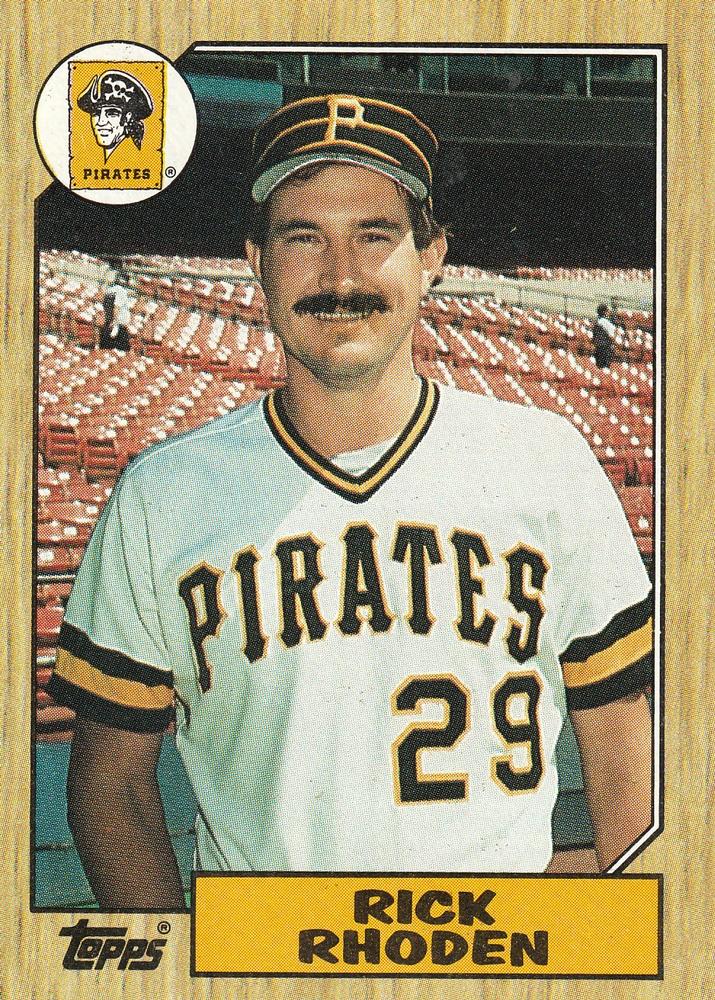
For many years, the debate over the best hitting pitcher remained alive and well. Historically, there’s Bob Lemon and Don Newcombe, and, of course, Babe Ruth. In the modern game, you have Madison Bumgarner, Mike Hampton, Dontrelle Willis, and Carlos Zambrano. Nowadays, it’s hard to argue against Japanese phenom Shohei Ohtani being the answer, not just of this question, but also that of the greatest player of all time. When looking back through the rich history of the Pittsburgh Pirates, one pitcher stands out among those associated with the franchise’s past as the best to ever do it out of the box and off the mound: Rick Rhoden.
Rhoden, born and raised in Palm Beach County, Florida, overcame osteomyelitis as an adolescent. Selected out of high school by the Dodgers in the first round in the 1971 draft, he quickly rose the ranks in the minors and debuted with the big club at the age of 21 in 1974. With Los Angeles, he was an All-Star in 1976, posting a superb 12-3 record along with a 2.98 ERA, and a member of two pennant-clinching teams.
The Dodgers did, however, lose both the 1977 and 1978 World Series to the New York Yankees. After the emergence of another promising rookie in Bob Welch, Rhoden was moved to the bullpen late in the 1978 season. Soon after the 1979 campaign began, he was traded to the Pirates, in exchange for former All-Star Jerry Reuss. This deal worked out well for both sides, as each player’s best years came with their respective new team.
Rhoden made only one start for the Bucs in 1979, against the Braves on May 8, giving up four runs over five innings with just two strikeouts, taking the loss in the Braves’ 4-1 victory. Pittsburgh was aware that Rhoden had been dealing with some arm trouble at the time of the trade, but it ended up being more serious than originally thought. The following month, he underwent shoulder surgery, ending his first season with the Pirates prematurely. As a result, Rhoden was not a “member” of the Bucs’ ‘79 championship team, an accolade that evaded him over the course of his 16-year major league career.
It took Rhoden a few years to establish himself as a starter in the Pirates’ rotation, but when he did, the finesse pitcher with strong control was one of its best for the decade of the 1980s. Rhoden broke out in 1983, greatly improving his ERA from 4.14 the previous year to a stellar 3.09. The Bucs had a strong staff that year, on a team that finished second in the NL East, after starting off the ‘80s to mediocre results.
In the shadow of the Pittsburgh Drug Trials, the Pirates were a disappointment to fans on and off the field. These years, specifically the early to mid ‘80s, are easily the darkest in franchise history, with not much to show for them besides a few standout performers, such as Rhoden. Rhoden wasn’t just a great pitcher; he could swing it, too. Some batting highlights of Rhoden’s tenure with Pittsburgh include a .375 average in 1980, tying a career high three home runs in 1982, and hitting safely in eleven straight games in 1984.
You could argue Don Robinson was the better hitter, but Rhoden did more in fewer plate appearances. He won the Silver Slugger three times, in 1984, 1985, and 1986. Rhoden was also an All-Star in ‘86, and contributed a career-best 6.6 bWAR, placing fifth in the NL Cy Young voting. For five seasons with the Pirates, he had a perfect fielding percentage, making him worthy of a Gold Glove. On all fronts, Rhoden was a professional, plain and simple.
Eventually, Rhoden was traded, per his request, to the Yankees in a deal that saw future Cy Young Doug Drabek included in the return. This trade was a clear win for Pittsburgh, as Drabek became the ace the Bucs needed in their young core to lead them to three consecutive NL East titles. Rhoden, to his credit, had a decent year with the Yanks in ‘87, winning 16 games, but was clearly on the back nine of his career. In 1988, he made history on June 11 as the first pitcher to start a game as a designated hitter.
In two plate appearances, he grounded out and hit a sac fly in New York’s win over Baltimore. Not long after the calendar year turned, Rhoden was traded that offseason to the Astros, as Houston had a clear need in their rotation after the departure of the legendary Nolan Ryan. 1989 would be Rhoden’s last as a big leaguer. For the ‘Stros, he started 17 games, going 2-6 with a 4.28 ERA and just 41 strikeouts.
After his baseball career, Rhoden began a unique journey in the world of professional golf, becoming one of the most accomplished multi-sport athletes of his era. He has several top finishes in PGA Champions Tour events, has won the American Century Championship numerous times, and is a regular competitor in celebrity golf tournaments. This remarkable transition from baseball to golf has no comparison.
A similar case with another sport is Beaver’s John Burkett, an All-Star pitcher and veteran of 15 seasons, who went on to become a professional bowler. Rhoden was an avid golfer when he was with the Pirates and took the game more seriously after retirement. This hard work certainly paid off for him, in more ways than one. Rhoden’s greatness as a pitcher, hitter, and golfer makes him a one-of-a-kind athlete and Pittsburgh Pirate, a special type of player we may never see again. Let’s see Ohtani’s short game.