
By Brian Kopycinski
When you think of Pittsburgh Steelers football, you think of defense and the run game. Legends like Franco Harris and Rocky Bleier led the way to four Super Bowl championships alongside the Steel Curtain of Mean Joe, Greenwood, Holmes and White. Still, nothing lasts forever. A stretch of mediocrity followed as this core aged and left the game. The 1980s weren’t just unkind to the Steelers, as the Bucs dealt with the fallout of the Pittsburgh Drug Trials.
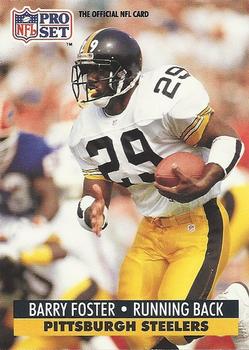
The ‘90s, however, brought new light to the sports scene as the city transitioned from an industrial to a more modern economy heading towards the 21st century, with several new stars making a name for themselves. You had Bonds, Bonilla and Van Slyke, Lemieux and Jágr. All-Stars, champions. It took a few years for the Steelers to get going in the new decade under head coach Bill Cowher. One player who stood out as a potential successor to Franco that has gone severely underappreciated is Barry Foster, a legend in his own right.
Foster grew up in the Dallas area and played his college ball at Arkansas, helping lead the Razorbacks to back-to-back Southwest Conference championships and Cotton Bowl appearances in the late ‘80s. Under head coach Ken Hatfield, Foster thrived in the wishbone offense, rushing for 833 yards and 7 touchdowns during his senior season. The Steelers drafted him in the fifth round, 128th overall in 1990, joining a crowded running backs room that included former first-round pick Tim Worley and Merril Hoge. Foster didn’t see too much action in his first year, though he made a notable blunder on special teams that led to a Steelers’ loss. This rookie mistake didn’t define him, and after an improved sophomore campaign, Foster took the reins after Worley was suspended for the season after failing drug tests.
For the team, the past two seasons had been up and down in Chuck Knoll’s twilight years. Bubby Brister won nine games as a starter in ‘90, but the Steelers regressed the following year to a 7-9 record. 1992 would be the dawn of a new era, with the introduction of Cowher as the Steelers’ new coach, who would name Neil O’Donnell, another 1990 draft pick, the starting quarterback. What Foster did that season was simply unprecedented. Nobody could have expected him to breakout the way he did. As a fifth-round draft pick, he went from being a backup to setting the franchise record for the most rushing yards in a single season at 1,690. This record still stands to this day.
The 1992 season was a look at what was to come under Coach Cowher. The Steelers won the AFC Central Division at 11-5, though they quickly exited the playoffs in a loss to Frank Reich and the Bills, coming off their historic comeback in the Wild Card over the Oilers. Despite the blowout defeat at Three Rivers, Foster still had over 100 yards rushing in the game. O’Donnell threw two interceptions in the Steelers’ 3-24 loss to Buffalo. Coming off such a historic campaign, that included twelve 100-yard performances, Foster was recognized by numerous accolades that included a Pro Bowl nod, First Team All-Pro honors and finishing second in the AP MVP vote to Steve Young.
Next year, Worley was traded to the Bears, giving Foster a firm lock on RB1 moving forward. After what he did in ‘92, this move should have come as no surprise. Foster had another Pro Bowl Season in 1993 but missed some games due to injury. In nine games, he rushed for a total of 711 yards with 8 touchdowns. The Steelers lost again in the playoffs, this time to the Chiefs in the Wild Card. 1994 was another disappointing season for Pittsburgh. While there was another AFC Central title and playoff victory over the Browns to celebrate, losing to the Chargers in the Conference Championship when favored was no way to go out. For Foster, who dealt with ankle and knee injuries again that year, it would be his last NFL game.
The reasons for this are several. There was Foster’s contract, the emergence of Bam Morris, and the signing of Erric Pegram. More than anything, the damage to one’s body that the game of football all but guarantees became too much for him to bear. Foster was traded to the expansion Panthers in May of 1995 but was soon cut after failing his physical. Later that season, he signed with the Bengals for a hefty sum after number one overall pick Ki-Jana Carter went down, then quickly changed his mind and retired once again, at just 26 years old.
Not long after Foster left, the Bus made a stop in Pittsburgh. On Draft Day, Jerome Bettis was traded by the Rams to the Steelers in exchange for draft capital. The rest is history, culminated by another Lombardi hoisted high a decade later. Bettis went out on top, beloved by fans. He’s in the conversation for the best Steelers running back of all-time, up there with Franco Harris. If you were to steer this discussion to the greatest season by a Steelers back, look no further than Barry Foster’s 1992 masterpiece. His peak deserves to be talked about in the same light. Most ‘90s football fans remember a Barry, that is, Barry Sanders. In 1992, “that” Barry was a Pittsburgh Steeler. For one spectacular season, Foster ran with the best of them. Let’s never forget that. Since his playing days, Barry Foster has been a middle school football coach and assistant principal in his home state of Texas.