
By Brian Kopycinski
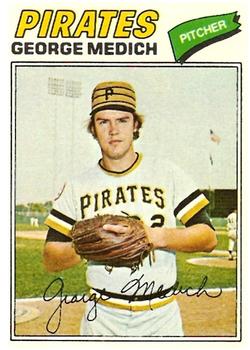
In recent years, the Pittsburgh Pirates have been involved in some historically bad trades, from Jason Schmidt and Aramis Ramírez to Chris Archer and Gerrit Cole. One that stands out among the worst in the franchise’s storied history is the deal, completed on December 11, 1975, that sent second baseman Willie Randolph to the New York Yankees in a package that included Ken Brett and Dock Ellis for starter George “Doc” Medich, a Pittsburgh native. On its own, this trade was undeniably bad, but with greater context it wasn’t as horrible as it seems.
Dave Cash, the Pirates’ primary second baseman on the 1971 World Series team, was traded to the Philadelphia Phillies in October 1973 for Ken Brett, George Brett’s older brother. Cash had shown great promise at the keystone in the years following Bill Mazeroski’s retirement. Rennie Stennett then took over second after Cash’s departure, becoming a reliable presence in the Bucs’ lineup. Still, it’s fair to say that Pittsburgh hadn’t found a true successor to Maz. Randolph, a highly touted prospect, certainly would have been worthy of this mantle had he remained a Pirate.
Brett was coming off the best season of his career to that point with the Phillies in ‘73, posting a 13-9 record in 25 starts and 31 appearances, with 111 strikeouts and an ERA of 3.44. As an 18-year-old rookie, he made history with the Boston Red Sox in 1967 as the youngest to ever pitch in a World Series. With Pittsburgh in 1974, Brett was an All-Star, earning the win in the Midsummer Classic hosted at Three Rivers Stadium, yet the swingman with a good bat was viewed as expendable. Ellis, best known for his no-no while allegedly under the influence of LSD, had worn out his welcome. On its face, the trade made sense for both sides.
The Pirates, aiming to repeat as NL East champs, hoped to bolster their young rotation, which featured John Candelaria, Bruce Kison, and Jerry Reuss, with the addition of Medich as a potential staff ace. The tall, hard throwing righty was a solid starter that showed great potential in his three full seasons with the Yankees, on otherwise mediocre teams. In 1973, Medich finished third in AL Rookie of the Year voting that Baseball-Reference values at 4.8 WAR. In 32 starts, Medich went 14-9 in 235 innings, striking out 145 to an ERA of 2.95. His innings total would increase the following campaigns, highlighting his durability.
Medich was a standout athlete at Hopewell High School in Aliquippa, Beaver County, excelling in basketball and football in addition to baseball. He attended the University of Pittsburgh, where he joined the Panthers’ baseball and football teams, as a tight end and punter on the gridiron. A 30th round selection of the Yankees in the 1970 June Amateur Draft, the pre-med student was committed to continuing his studies. In the minors, Medich would sometimes end his seasons early to return to medical school at Pitt, and miss spring training, often reporting late.
For the Yankees, following the malaise of the Horace Clark Era, it was now or never after the blockbuster signing of Jim “Catfish” Hunter on New Years Eve, 1974. Sandy Alomar Sr. had manned second for the Bronx Bombers the past few seasons to uninspired results. Outside of Hunter, the Yankees had seen decent if not inconsistent performance from the back end of their starting rotation, from the likes of Pat Dobson, Larry Gura and Rudy May. The possibility and experience Brett and Ellis presented appealed to New York. Randolph was widely seen as the prize of all prospects that winter. Before his major league debut on July 29, he was hitting .339 for the Triple-A Charleston (West Virginia) Charlies. At the time, writers generally saw the trade as an even deal, with some even giving the edge to Pittsburgh.
The Yankees made another big move that day, shipping the slugging Bobby Bonds to the California Angels for pitcher Ed Figueroa and outfielder Mickey Rivers, who became key pieces, not to mention Randolph, to the championship puzzles in ‘77 and ‘78. Ellis returned to form in 1976, winning 17 games for the pennant clinching Yanks. Brett was dealt to the Chicago White Sox in May, where he posted one of the best seasons of his career. Following their breakout campaigns, both Brett and Ellis bounced around the league for the remainder of their careers, with varying levels of success. Randolph, however, emerged as one of the finest second basemen of his era, and today has a place in Monument Park. For Pittsburgh, he only got into 30 games in 1975, hitting just .164 in 61 at-bats. Randolph also went hitless in his two plate appearances in the NLCS, as the Pirates were swept in three games by the eventual World Series champion Cincinnati Reds.
Unfortunately for the Pirates, Medich never lived up to the billing with his hometown team. In just one season with the Bucs, he went 8-11 with a 3.51 ERA in 26 starts, striking out just 86 batters. That year, the team finished second in the NL East nine games behind the Phillies, with a record of 92-70 under longtime manager Danny Murtaugh. It wouldn’t be long before Medich found his way on a new ball club. Before the 1977 season began, he was traded in a nine-player deal to the Oakland Athletics. Frustrated by the move, Medich seriously considered quitting the game.
The remainder of his career would have its ups and downs. He found a home with the Texas Rangers for four and a half seasons, where he showed flashes of greatness. As a member of the ‘82 Brewers, he pitched in Game 6 of the World Series, where he gave up six runs, four earned, in two innings. After leaving baseball, Medich was arrested in 1983 for writing illegal prescriptions. He has since admitted to being addicted to painkillers and muscle relaxers, as a way to cope with stress and injury during the last season of his playing career. Medich, an orthopedic surgeon, was charged and convicted on a similar offense in 2001.
With Medich, the A’s received longtime fireman Dave Giusti and prospects Tony Armas, Doug Bair, Rick Langford, and Mitchell Page. In return, the Pirates acquired All-Star Phil Garner, a veteran in Tommy Helms and a rookie in Chris Batton. A few months prior, Manny Sanguillén had been dealt in a rare player for manager trade, for New Castle’s own Chuck Tanner.
Years removed from tearing down his dynasty, A’s owner Charlie Finley wasn’t done just yet. Garner, who wanted more money, was a perfect fit for Pittsburgh at third, after Richie Hebner signed with the Phillies. Garner came up through the minors at the hot corner but was blocked at the position by Sal Bando. There was an opening at second after Oakland released Dick Green to begin 1975. Armas and Page faced stiff competition in Pittsburgh’s outfield, consisting of Al Oliver, Omar Moreno and the late Hall of Famer Dave Parker. If not for a change of scenery, it’s possible their careers could have gone in completely different directions.
Armas, a feared power hitter in the American League for Oakland and Boston, slugged 251 long balls for his career. He led all the major leagues with 43 homers for the Red Sox in 1984, the first Venezuelan player to ever do so. Page, who had a respectable career himself, finished second in AL Rookie of the Year voting in 1977 with a .307 batting average, 21 home runs and a .926 OPS. The award went to future Hall of Famer “Steady” Eddie Murray, who by all accounts had a great season, though it’s debatable whether he should have won it or not, with Page’s 6.1 bWAR to Murray’s 3.2. We can always speculate on players, but they remain nothing more than what-ifs.
Giusti, one of the greatest closers in Pirates’ history, had a good 1977 with the A’s but struggled after being purchased by the Chicago Cubs, retiring shortly after the conclusion of the season. Bair, a journeyman reliever, was a member of two World Series champions, the ‘82 Cardinals and the ‘84 Tigers. Langford was a workhorse starter for the A’s for a decade, who led the league twice in complete games, in 1980 and the strike-shortened 1981 season. Helms, the 1966 NL Rookie of the Year for the Reds, played sparingly for the Bucs, and like Giusti, called it a career in ‘77 after a brief stint with the Red Sox. Batton, who had a cup of coffee with Oakland in ‘76, never suited up for the big-league club in Pittsburgh.
Randolph is up there with Bobby Grich and Lou Whitaker as the best second basemen not in the Hall of Fame. While he was on the ballot just once in 1998, garnering just 1.1% of the vote, Cooperstown remains a possibility someday via the veteran’s committee. Regardless, Willie Randolph had a heck of a career, as a player and a coach. He was consistently great, having one of his best seasons at the age of 36 with the Milwaukee Brewers in 1991, never falling off a cliff over the course of 18 years like some all-time greats eventually do. Randolph was a six-time All-Star and World Series champion. Later, he became the Yankees’ third base coach, contributing to another dynasty in New York. Randolph also found success as the manager of the New York Mets, the team the Brooklyn son grew up rooting for.
Still, there remains a lasting silver lining to an otherwise clear Pirates blunder, that being a championship of their own. The late ‘70s were a special time for Pittsburgh sports, with the Pirates, Pitt Panthers, and Steelers all claiming titles. The “We Are Family” Bucs, led by “Pops” Willie Stargell, were a truly iconic team, defeating the Baltimore Orioles in seven games in a rematch of the 1971 Fall Classic. One of the key, often overlooked, contributors to this World Series was Phil Garner, who batted .500 with a total of 12 hits, as did Stargell, hitting .400 in 30 at-bats. The pair are currently tied with a handful of others for the second most base hits in a single World Series, with Marty Barrett, Lou Brock, and Bobby Richardson topping the list with 13. Stargell, the ‘79 NL co-MVP alongside Keith Hernandez, also took home NLCS MVP and World Series MVP honors in a remarkable postseason run.
Another thing to keep in mind is that stats aren’t everything. There’s a lot that doesn’t show up on the box score. Why do you think they called Garner “Scrap Iron”? It’s difficult to compare him to someone like Randolph. They’re simply different players. Earlier in his career, Garner, too, was a threat on the base paths, though he wasn’t the finest fielder. Randolph certainly has him in this department, though he himself was overshadowed at the position defensively by Frank White and the aforementioned Whitaker. If you’re just looking at WAR, then Randolph is clearly the better player, but the value of someone like Garner to a ball club shouldn’t be understated. After Pittsburgh, he had some good years with the Houston Astros, who he’d later lead to a National League pennant in 2005 as their skipper.
While many Pirates fans think of Willie Randolph as “the one that got away”, a World Series ring in ‘79 is a nice consolation prize. It’s also worth mentioning that the Yankees, who won the most games in the 1980s, never won a championship with Randolph in this span, though they came close in ‘81. Don’t forget that Garner was traded that season to Houston for another underappreciated second baseman in Johnny Ray. Ray finished second in NL Rookie of the Year voting after he took over second full-time in 1982. The following season, he won the Silver Slugger Award, so it’s not like the position was devoid of talent following the loss of Randolph. Would a player of his caliber have helped extend the Bucs’ championship window? It’s unlikely, given the play of Stennett, Garner, and Ray over these years.