
By Brian Kopycinski
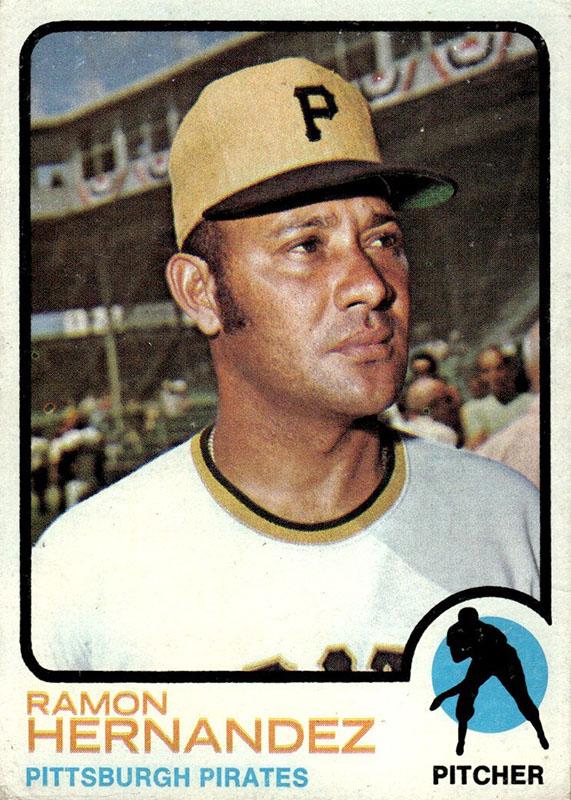
Ramón Hernández was a fiery competitor for the Pirates in the early 1970s, a crafty relief specialist whose unusual delivery made him something of a pioneer for his era. The left-hander hailed from Carolina, Puerto Rico, the same suburb of San Juan that produced “The Great One,” Roberto Clemente. Hernández debuted in the Puerto Rican Winter League shortly after his 18th birthday, and for the next two decades he returned home each offseason.
Hernández’s path to the major leagues was anything but conventional. He first joined the Pirates organization in 1959 as an amateur free agent, beginning a professional career that would span multiple eras. His early years were difficult. He struggled in the minors, endured a suspension, and sat out the entire 1961 season. Pittsburgh eventually sold his contract to the Los Angeles Angels, where he spent several seasons working as both a starter and a reliever without much success.
In 1966, Hernández was selected by the Atlanta Braves in the Rule 5 Draft. He broke camp with the club in 1967 as a 26-year-old rookie and spent the entire year in the majors, though his performance was largely replacement-level. After the season, he was claimed by the Chicago Cubs in the Rule 5 Draft, only to continue struggling against major league hitting. His contract was soon purchased by the St. Louis Cardinals, sending him back to the minors once again.
Hernández spent the remainder of the 1968 season at Triple-A Tulsa, where results were still uneven. The 1969 season, however, marked a turning point. Pitching for the Cardinals’ Double-A affiliate in Arkansas, he showed significant improvement. Around this time, Hernández also gained a reputation for a volatile temper and frequent clashes with players and management. St. Louis ultimately released him, and he resurfaced in 1970 with the Mexico City Reds of the Mexican League. There, Hernández finally showed the talent that had been missing, posting a 1.82 ERA with 56 strikeouts in 32 games.
More than a decade after first joining the organization, Hernández returned to the Pirates in February 1971, acquired in a trade that sent minor leaguer Danilo Rivas the other way. He pitched well enough at Triple-A Charleston to earn two in-season promotions, in June and again in September. During his brief time in the majors that season, Hernández posted a miniscule 0.73 ERA across 12.1 innings. Despite this strong showing, he was ineligible for the Pirates’ postseason roster and missed out on contributing to the club’s 1971 World Series run.
The 1972 season stands as the high point of Hernández’s major league career. A mainstay out of the bullpen, he shared save opportunities with Pirates great Dave Giusti and recorded 14 saves of his own. Over 70 innings, Hernández posted an elite 1.76 ERA, establishing himself as one of the National League’s most reliable relief arms. His deceptive sidearm delivery baffled hitters, particularly left-handers, and he mixed a fastball, curveball, and screwball from varying arm angles.
That success carried into October. Hernández made history in the 1972 NLCS by forming the first postseason Hispanic battery with catcher Manny Sanguillén, earning the save in Game 1. The Pirates fell short in the series, losing to the Cincinnati Reds. The year ended on a tragic note when Roberto Clemente, Hernández’s close friend and fellow Puerto Rican, died on December 31, 1972, in a plane crash while delivering humanitarian aid to earthquake victims in Nicaragua. Hernández, like the rest of the team, was devastated by the loss.
No doubt affected by Clemente’s death, 1973 was a down year for the Pirates, though not for Hernández. He enjoyed another strong season, posting career highs in innings pitched and strikeouts, good for 2.0 WAR. While Pittsburgh missed the postseason that year, the club rebounded to win the NL East in both 1974 and 1975, with Hernández remaining a steady presence out of the bullpen. He allowed no runs in two appearances during the 1974 NLCS versus the Los Angeles Dodgers but gave up two runs in Game 3 of the 1975 series against Cincinnati.
The 1976 season marked Hernández’s final year in Pittsburgh, as his contract was later purchased by the Cubs. His major league career concluded in 1977, a disappointing final chapter that saw him split time between the Cubs and the Boston Red Sox.
Over nine major league seasons, Hernández compiled 6.2 WAR, an ERA+ of 116, and 46 saves, finishing with a 3.03 career ERA. While Hernández never served as a full-time closer, his skill set indicates he could have thrived in that role. He instead became a trusted high-leverage arm at a time when bullpen roles were still undefined.
Following his big league career, Hernández continued pitching winters in his native Puerto Rico through the 1979–80 offseason, where his longevity placed him among the league’s most accomplished pitchers. Ramón Hernández passed away on February 4, 2009, at the age of 68. He was an unsung but essential contributor to four NL East championship teams, a pitcher whose impact rarely showed up in headlines but consistently appeared in the box score. In an era before modern bullpen roles were fully established, Hernández quietly mastered his craft, and in Pirates history, he remains one of the most effective and underappreciated relief pitchers the franchise has ever had.