
By Brian Kopycinski
By the late 1960s, the Pittsburgh Steelers were a struggling franchise in decline. Mediocrity defined the decade. It wasn’t until the early ’70s that the Steelers began to show life again under head coach Chuck Noll. Noll was hired in 1969 after Bill Austin was fired following another disappointing season. While Noll fared poorly in his first year on the job, with the Steelers finishing 1–13, the foundation was being laid for a championship team. “Mean” Joe Greene and L.C. Greenwood were selected in the 1969 NFL Draft. Terry Bradshaw and Mel Blount would follow in 1970.
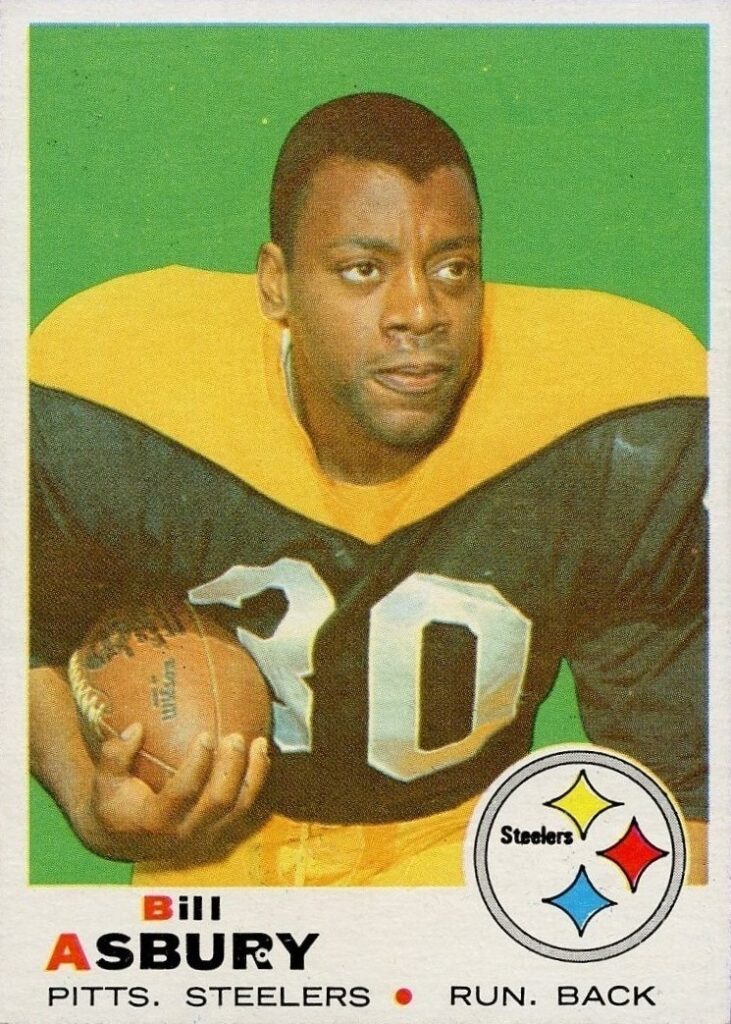
Before the Steelers became the Team of the Decade, an unprecedented dynasty that captured four Super Bowl championships, an unremarkable culture had been the standard. While these middling teams did little in the way of winning, there was still plenty of talent in black and gold. Roy Jefferson was an All-Pro, and Ben McGee a defensive stalwart. Another standout from this era is Willie Asbury, a Kent State legend who led the Steelers in rushing as a rookie in 1966. While his playing career was short, his improbable journey to the NFL and his remarkable life after football make for a story worth telling.
Born in Crawfordville, Georgia, Asbury graduated from Cincinnati’s Princeton High School. The school counts several professional athletes among its alumni, including Josh Harrison and Paris Johnson. As a senior, Asbury was named All-City and All-Country in football. After graduation, he enrolled at Kent State University, about a four-hour drive northeast of Cincinnati. In his sophomore year, Asbury ran for 349 yards and three touchdowns as the Golden Flashes’ leading rusher. He missed the 1964 season after suffering a near-fatal kidney disorder. Asbury collapsed after completing a mile run during conditioning and was later diagnosed with acute renal failure. He was admitted to the hospital, lost 58 pounds, and eventually recovered.
Asbury returned in 1965, leading his team and conference in rushing with 998 yards and scoring six touchdowns. The Flashes went 5–4–1 that year, and Asbury was named MAC Offensive Player of the Year. He also earned Associated Press honorable mention All-American honors. In addition to football, Asbury was a track standout at Kent State, setting the school’s shot put record. He earned his bachelor’s degree in sociology in 1965.
Asbury was drafted by the Atlanta Falcons, an expansion team, in the fourth round of the 1966 NFL Draft. He was later cut and signed by the Steelers. Asbury had met with Art Rooney Jr. several times before the draft during his senior year, and Rooney saw great potential in him.
The Steelers were coming off another down year, finishing 1965 at 2–12, their second consecutive losing season. Head coach Mike Nixon was let go after just one year, and Bill Austin was brought in on the recommendation of Vince Lombardi, under whom Austin had served as an offensive line coach for five seasons. This period of Steelers history was defined by inconsistency on both sides of the ball. As noted, it would be several years before the Steelers became relevant again under Chuck Noll. Austin coached Asbury during his three years with the team.
As a rookie in 1966, what would be his finest season, Asbury led the team with 544 rushing yards and seven touchdowns. He started all fourteen games, wearing No. 30. He also totaled 228 receiving yards and two touchdowns.
He scored his first career touchdown in Week 1 at home against the New York Giants, in the second quarter of a 34–34 tie. Three different quarterbacks started for the Steelers that year, George Izo, Bill Nelsen, and Ron Smith, with mixed results. Pittsburgh finished 5–8–1, good for sixth place in the NFL East Division.
In 1967, Asbury split carries with Earl Gros, rushing for 315 yards and four touchdowns, while Cannonball Butler and Don Shy also contributed in the backfield. In Week 1 against the Chicago Bears, Asbury tied Minnesota’s Dave Osborn for the NFL’s longest rushing attempt that season with a 73-yard gain. In the Steelers’ 41–13 victory, he totaled 107 yards and two touchdowns. Despite Asbury’s impact, Pittsburgh failed to improve, finishing 4–9–1 and last in the Century Division.
1968 was Asbury’s final season in the league. He was largely a non-factor in the Steelers’ offense, with just four rushing attempts for nine yards and three catches for 27 yards in seven games. Dick Hoak emerged as a Pro Bowl talent, rushing for a career-best 858 yards. It was another dismal season for the black and gold, who finished 2–11–1. Austin was fired, and the Steelers took a new direction by hiring Noll, a defensive coach with the Chargers and Colts.
Heading into the 1969 season, Asbury was cut in August and retired from the game. He quickly pivoted to professional life, beginning with Sanford Rose Associates in Akron. From there, he joined the Akron Human Relations Committee and later took a position at his alma mater. He earned his M.A. in sociology from Kent State in 1973. In 1981, he was inducted into the Kent State Athletics Hall of Fame.
Asbury eventually joined Penn State University, serving as an Affirmative Action Officer, Assistant to the Provost, and Executive Assistant to the President for Administration. He was promoted to Vice President of Student Affairs in 1987, a position he held until 2003.
Willie Asbury enjoyed an accomplished career in both football and higher education. With the Steelers, he totaled 868 rushing yards and eleven touchdowns, along with 307 receiving yards and two touchdowns. His work at Penn State was just as important to him, a career that gave him renewed purpose. At 83 years of age, Asbury remains a living legend from an overlooked era of Steelers football, his legacy defined as much by his work off the field as what he accomplished on it.