
By Brian Kopycinski
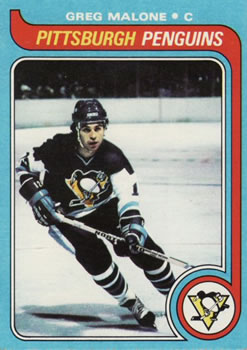
Before the arrival of Mario Lemieux, the upstart Pittsburgh Penguins had their fair share of talent, from Jean Pronovost to Rick Kehoe and Pierre Larouche. While these teams were often competitive, they ultimately fell short of their goal of hoisting Lord Stanley’s Cup. Early playoff exits became the norm through the early 1980s, before a steep drop-off forced the franchise into a necessary rebuilding period. One of the more underrated players from this era is Greg “Bugsy” Malone, who remains deeply tied to the city of Pittsburgh to this day. Although he last played for the Penguins more than forty years ago, Malone still ranks in the top 20 in franchise history in goals, assists, and points. His family’s enduring connection to the game further strengthens his lasting legacy.
Malone grew up in the Chatham neighborhood of Miramichi, New Brunswick, before his family later moved to Fredericton. There, he attended the local high school and played hockey. Malone helped lead the Fredericton Black Kats to a provincial championship in 1973, winning the scoring title with a remarkable 76 points (35 goals, 41 assists) in just 23 games. He went on to play junior hockey in the Ontario Hockey Association with the Oshawa Generals for three seasons, averaging 70 points per year. Malone was selected by the Penguins in the second round, 19th overall, of the 1976 NHL Amateur Draft. He made the immediate jump from junior to the NHL and suited up for Pittsburgh during the 1976–77 season.
Malone was a balanced forward, a dangerous goal-scorer and a reliable playmaker. As a rookie, he made an immediate impact, recording 18 goals and 19 assists on a Penguins team that returned to the playoffs. In a Preliminary Round rematch, the Penguins fell once again to the Toronto Maple Leafs, though Malone scored a goal in the Game 2 victory and added an assist in the deciding Game 3 loss. He followed up that strong debut with a 61-point campaign in 1977–78, despite Pittsburgh missing the postseason and finishing fourth in the Norris Division. Malone’s best season in a Penguins sweater came in 1978–79, when he posted a career-high 65 points (35 goals, 30 assists) while playing all 80 games. That year, the Penguins returned to the Stanley Cup playoffs and defeated the Buffalo Sabres 2–1 in the opening round, with Malone contributing an assist in the Game 2 loss at the Pittsburgh Civic Arena.
That momentum proved short-lived, as the Penguins were swept by the Boston Bruins in the Quarter-Finals. Malone was held scoreless in the series, and Pittsburgh once more fell short of a deeper playoff run. In the seasons that followed, Malone remained a reliable presence, recording back-to-back 50-point campaigns. The team’s struggles persisted, with early playoff exits against the Bruins in 1980 and the St. Louis Blues in 1981. Malone maintained this production despite playing only 51 and 62 games in those respective seasons. A down year followed in 1981–82, as the Penguins were eliminated in the Preliminary Round by the Islanders. Malone rebounded in 1982–83 with another 60-point season, highlighted by a career-best 44 assists. The team, however, was in clear decline, finishing 18–53–9 for just 45 points. With a full rebuild underway, Malone was traded to the Hartford Whalers in September 1983 for a fifth-round draft pick.
Regardless of where he played, Malone continued to produce offensively. On struggling Whalers teams, he posted 54- and 61-point seasons, even as Hartford remained near the bottom of the Adams Division. He was traded midway through the 1985–86 season to the Quebec Nordiques in exchange for former Penguin Wayne Babych. By this stage of his career, Malone was no longer the impact player he once was, recording just 21 points between the two teams that season. After appearing in only six games for the Nordiques the following year, his playing career came to an end. Over 11 NHL seasons, Malone totaled 191 goals and 310 assists for 501 points. It did not take long for him to return to the game in a different capacity.
Hired by the legendary Tony Esposito, who served as the Penguins’ general manager, Malone became a scout for his former club. He eventually rose to the role of chief scout and earned two Stanley Cup rings for his work in the front office. Malone held that position in Pittsburgh until 2006 before later joining the Phoenix Coyotes organization. He ultimately settled in the Steel City, where he raised his two sons, Ryan and Mark.
Ryan Malone was selected by the Penguins in the fourth round of the 1999 NHL Draft and spent four seasons with the team before later playing for the Tampa Bay Lightning and New York Rangers. Greg and Ryan achieved a rare distinction, becoming one of only two father-son duos in NHL history to each record a hat trick, the others being Ken Hodge Sr. and Ken Hodge Jr. Mark Malone played collegiate hockey at Nichols College before embarking on a professional career in the ECHL with the Wheeling Nailers and Bakersfield Condors. Greg’s brother, Jim Malone, was a first-round pick of the New York Rangers in 1980 and enjoyed a lengthy professional career of his own. Jim’s son and Greg’s nephew, Brad Malone, went on to play parts of nine NHL seasons.
Greg Malone was inducted into the New Brunswick Sports Hall of Fame in 2000 and later founded the Malone Family Foundation, which helps provide access to hockey through equipment and facilities for local families in need. Through his playing career, front-office contributions, and continued commitment to the sport, Malone has left a lasting impression on the city of Pittsburgh. He remains an overlooked star from the franchise’s early years and one of the Penguins’ most important players of the pre-Lemieux era.