
By Brian Kopycinski
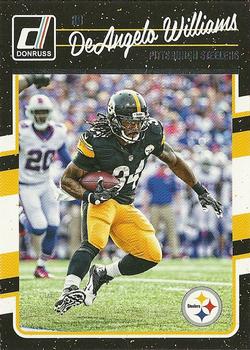
When the Steelers needed him most, DeAngelo Williams stepped up. The Panthers’ 2006 first-round pick had been a dynamic playmaker throughout his nine-year tenure with Carolina. Pittsburgh needed an insurance policy for their star running back Le’Veon Bell, who was coming off an All-Pro season. Williams filled in admirably for Bell whenever the opportunities came. He greatly exceeded expectations for a back in his early-30s and quickly became a fan favorite in Pittsburgh. Over his 11 seasons in the NFL, Williams made an impact as a player and advocate for the cause of breast cancer awareness, invaluable both on and off the field.
At Memphis, Williams was one of the best running backs in college football. His 22 touchdowns as a junior led the FBS, as did his absurd 1,964 rushing total his senior year. He was the third running back taken in the 2006 draft, after Reggie Bush and Laurence Maroney. While the Heisman Trophy ultimately went to Bush, Williams finished seventh in the award voting that cycle. Selected 27th overall, he would go on to become one of the greatest backs in Carolina’s history, setting several franchise records along the way. Although the Panthers never found much postseason success in his time with the team, Williams still shined on the biggest stage. In 2008, he rushed for 1,515 yards and led the league with 18 touchdowns, earning him a second-team All-Pro nod. He followed this up with another 1,000-yard season and was named to the Pro Bowl.
With 6,846 yards rushing in a Panthers’ uniform, Williams ranks second in franchise history, behind his teammate Jonathan Stewart. Stewart and Williams were one of the strongest running back tandems in the league when they played together. Williams also ranks third in rushing touchdowns, behind Stewart and Cam Newton. After nine seasons, Carolina released Williams in March 2015, and shortly after he signed with the running back-needy Steelers. LeGarrette Blount was waived the previous season, and Pittsburgh had a true need at the position. Williams fit the role perfectly, a veteran back that still had a lot to give in the run game and as a mentor to Bell. In 2014, while the Steelers won the AFC North at 11-5, they quickly exited the playoffs in a Wild Card loss to the Ravens. With the Killer B’s in their prime, Pittsburgh hoped to take a step forward in the new calendar year.
With Bell out for two games, Williams opened the season as the Steelers’ lead back. In a Week 1 loss at New England, he rushed for 127 yards on 21 carries, a promising sign of what was to come. In the Steelers’ blowout victory over the 49ers in Week 2, Williams ran for 77 yards and 3 touchdowns. Once Bell returned, however, he reverted to his reserve role. It wouldn’t be until Week 8 that Williams made headlines again, after Bell went down with a season ending MCL injury courtesy of Cincinnati’s Vontaze Burfict. While Pittsburgh lost a close one 16-10, Williams did his job, rushing for 71 on 9 carries, taking over for Bell in the second quarter. He followed this up next week with a career game in a shootout against Oakland, going for 170 and 2 scores in the 38-35 win.
Pittsburgh had won five of their last seven going into their Week 17 matchup at Cleveland, with a record of 9-6 to that point. Unfortunately for the Steelers, they would lose another key player in Williams, who went down with an ankle injury and would be out for the playoffs. For the regular season, Williams was the team’s leading rusher in just ten starts, with 907 yards on the ground and 367 through the air, giving him 1,274 from scrimmage, along with a league leading 11 rushing TDs. The Steelers would go on to defeat the Bengals in the Wild Card, with Jordan Todman and Fitzgerald Toussaint leading the backfield. Pittsburgh then fell to Peyton Manning and the eventual Super Bowl champion Broncos in the next round, 23-16. Had Bell and Williams both been healthy, who knows what would have happened?
To begin the 2016 season, Bell was suspended again, this time for three games. Williams was called upon again to be the team’s workhorse back, and he didn’t disappoint. In Week 1 against Washington, Williams had 143 yards rushing and two touchdowns, to earn himself AFC Player of the Week honors in the Steelers’ win over the Redskins. Still, when Bell came back, Williams was now the backup, again. Bell stayed healthy for the remainder of the season and had another career year, 1,268 yards rushing to go with 7 TDs. Williams, making four starts, had just 343 yards, although he found the endzone 4 times. After another great season, Pittsburgh advanced to the AFC Championship to face New England. In what would be his final game, Williams went for 34 rushing with a TD and had 7 receptions for 51 yards in a heartbreaking, and some would say controversial, Steelers’ loss.
After his contract expired, Williams became a free agent. He failed to sign with a team for the 2017 season, and did not announce his retirement until 2018. As a player, he honored his late mother Sandra with his strong dedication in spreading awareness of breast cancer, likely saving many lives. Williams has been very active following his football career. He became a professional wrestler, joining Impact and TNA, and starred on Season 32 of The Amazing Race, where he and his former Panthers teammate Gary Barnidge finished 4th. On the field, Williams racked up over 10,000 yards from scrimmage and scored 70 total touchdowns. His work off it, however, likely means much more to him. Always a class act, DeAngelo Williams is remembered fondly by Panthers and Steelers fans alike for all that he’s done.